Nearly five decades after it left Earth, NASA's Voyager 1 is about to set a distance record that no other human-built object has approached. On Wednesday, November 18, 2026, the spacecraft will become the first thing made by people to reach one light-day from Earth, a marker that turns a familiar unit of astronomy into a hard, physical fact about how far the mission has traveled.
Voyager 1 was launched in 1977, two weeks after its twin, Voyager 2, though a faster trajectory and a different itinerary put it far ahead. It flew past Jupiter in 1979 and Saturn in 1980, using those encounters to bend its path outward, and in 2012 it crossed into interstellar space, the vast gap between stars. Voyager 2, which took the slower route past Uranus and Neptune, entered interstellar space in 2018 and will not reach the one light-day mark until 2035.
The milestone itself is an accounting of time and distance. A light-day is how far light travels in 24 hours: 16,094,799,096 miles, or 25,902,068,356 kilometers. Voyager 1 will arrive at that point at 5:16:07 a.m. EST on November 18, at which moment its radio signals will need a full 24 hours to reach antennas on Earth. NASA calculates that the spacecraft will have taken 49 years, two months and 11 days to put one light-day between itself and its home planet.
The probe is not slowing down in any meaningful sense. It is cruising at roughly 37,763 mph (61,000 kph) through a region of charged particles, magnetic fields and dust that scientists are still trying to characterize. A skeleton flight control team at NASA's Jet Propulsion Laboratory in Pasadena, California, sends commands about once a week, more often when something goes wrong. In September the team finished a power conservation campaign, and in October it briefly lost contact with the spacecraft, a disruption that engineers have not yet explained.
Key Facts
The numbers behind the milestone are precise. NASA Science reported on November 14 that Voyager 1 will be 16,094,799,096 miles (25,902,068,356 kilometers) from Earth at 5:16:07 a.m. EST on November 18, 2026, the exact instant its distance equals one light-day. The Associated Press reported on November 14 that the spacecraft is more than 16 billion miles (26 billion kilometers) from Earth and has been flying for 49 years.
Scale helps. NASA's explainer notes that the Moon is 238,855 miles away and light crosses that gap in 1.3 seconds, that sunlight takes about 8 minutes 20 seconds to reach Earth, and that radio signals to or from Mars take between three and 22 minutes. Neptune sits about four light-hours and 10 light-minutes away. A light-year, the unit that makes interstellar distances manageable, is about 5.88 trillion miles (9.46 trillion kilometers), and Voyager 1 would need another 18,000 years to cover one of those.
Power is the constraint that shapes everything. CNET reported on November 14 that the spacecraft's three radioisotope thermoelectric generators, which convert heat from decaying plutonium-238 into electricity, produced about 470 watts at launch and now produce about 215 watts, a loss of roughly 4 watts per year. Eight of the 10 instruments Voyager carried at launch have been switched off, and only two remain operating after a sudden power drop forced another shutdown.
Getting even that far required careful engineering. In 2026 the JPL team spent weeks turning off three devices and turning on three lower-power replacements, a campaign internally called The Big Bang that was also run on Voyager 2, and the work was completed in early September. The maneuver was complicated by the round trip: almost a full day for a command to arrive and another full day for the answer to come back.
The Associated Press reported on November 14 that Voyager 1 and Voyager 2 continue to return science and engineering data daily as they travel at 38,000 mph (61,000 kph). Al Jazeera reported on November 14 that the readings cover the strength and direction of the magnetic field, surrounding pressure, dust and galactic cosmic rays.
Analysis
What this really means is that the edge of the solar system is no longer a line on a diagram but a place with a measuring stick running through it. Voyager 1 has been in interstellar space since 2012, yet it remains bound to the sun by gravity and will be for a very long time. The one light-day mark does not change the physics of the mission. It changes the human accounting of it, converting decades of telemetry into a single round number that anyone can grasp.
The choice of a day as the unit is telling. Astronomers habitually speak in light-years and light-hours, while a light-day is the measure that happens to fit a working spacecraft. It is also the measure that describes the mission's operational reality: a command sent on Monday is executed on Tuesday, and a fault reported on Tuesday is understood on Wednesday. That delay, which grows by roughly 1.6 million miles a day, is why the flight team is skeletal and why problems take time to diagnose.
The October communications loss deserves attention rather than a footnote. Engineers briefly lost contact with Voyager 1 and have not determined why, according to the AP and Al Jazeera. A spacecraft that cannot be heard is, for engineering purposes, gone, and the team's ability to restore a link depends on hardware designed in the early 1970s and on retirees who know how to talk to it. The one light-day milestone therefore coincides with a period when the mission is one serious anomaly away from silence.
Project manager Suzanne Dodd has framed the probe as an ambassador. The Associated Press reported on November 14 that she called Voyager 1 a national treasure and described the work of the two probes as akin to that of weather satellites. The Planetary Society's Bill Nye said in a statement that everyone on Earth has been touched by these missions. That is sentiment, but it is also a fair description of a program that has outlasted its planners, its budget lines and most of the technology that built it.
Why It Matters
The milestone is a rare event in space science that requires no instrument, no peer review and no interpretation. It is arithmetic, and it can be checked by anyone with the right ephemeris. That makes it useful as a public marker of what long-duration exploration actually looks like: not a sprint to a finish line but a slow accumulation of distance, with each additional year of operation purchased by shutting something else down.
It also sets a benchmark against which future missions will be measured. Voyager 1 is headed toward a star more than 17 light-years away called AC +79 3888, also known as Gliese 445, in the constellation Ursa Minor, and NASA expects it to pass within about 1.7 light-years of that star in 40,000 years. The gap between 40,000 years and the 49 years already logged is the most honest summary of interstellar travel available to anyone.
And the mission is still producing science. Its daily measurements of the magnetic field, plasma pressure, dust and galactic cosmic rays are the only direct sampling of the interstellar medium that exists. Every additional year of data extends a record that cannot be repeated, because no follow-on probe is on a comparable trajectory.
Next Up
Attention now turns to the clock. At current power levels, NASA expects Voyager 1 to shut down its final science instrument in the 2030s and to lose communication with Earth around 2036, according to CNET. Voyager 2, which launched 16 days before Voyager 1, is on pace to be one light-day away in November 2035, likely after its instruments have gone quiet.
For now, the team at JPL will keep sending its weekly commands and watching a signal that takes a full day to arrive. On November 18 that number becomes exactly 24 hours, and the most distant object people have ever built will be one day of light away from home.
Related Articles
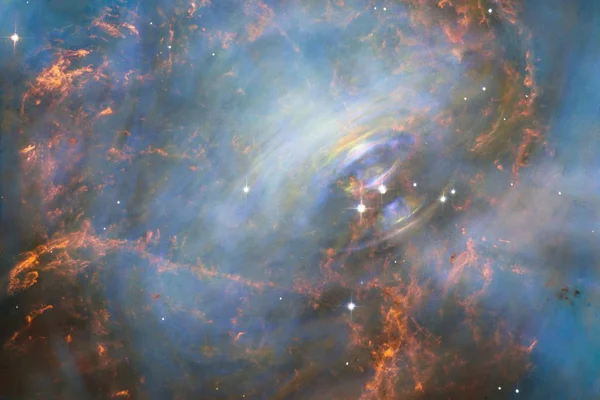
Invisible Companion in a Milky Way Binary May Be a Rare Supermassive Neutron Star
A red giant 4,800 light-years away is orbited every 1,217 days by a dark object of about 2.20 solar masses, a measurement that could place a neutron star inside the long empty mass gap.
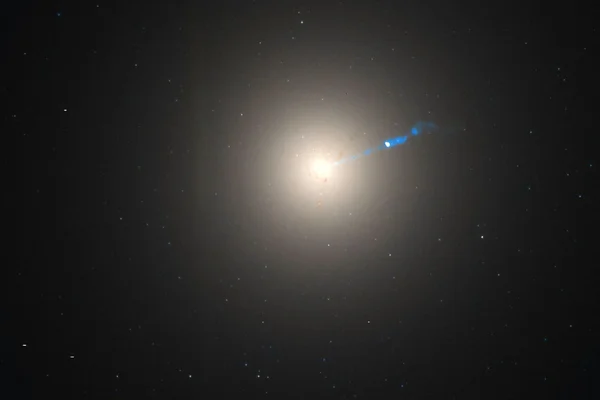
Independent CSIRO analysis confirms the 2019 black hole ring image of M87
A four person CSIRO team rebuilt the 2019 Event Horizon Telescope picture using calibration free observables and a model trained on cats and dogs, recovering the same 42.2 microarcsecond ring.
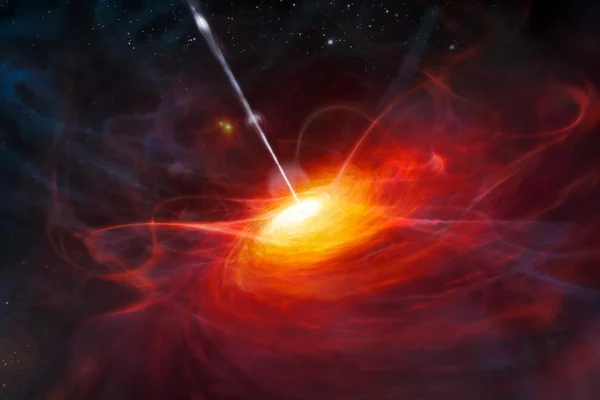
Astronomers Find Oldest Compact Quasar Pair, Two Giant Black Holes 900 Million Years After Big Bang
Two feeding black holes, weighing 1.5 billion and 400 million Suns, sit 18,100 light-years apart in a system seen 900 million years after the Big Bang.
Comments (0)
Log in or sign up to leave a comment.
No comments yet. Be the first to share your thoughts.