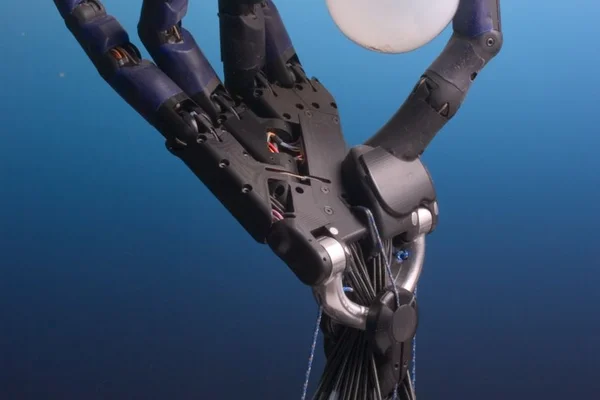
Boston Dynamics, the robotics affiliate of Hyundai Motor Group, unveiled a redesigned hand for its Atlas humanoid on October 1, 2026. The new assembly has four fingers and 13 degrees of freedom, abandons the pinky finger entirely, and is engineered from the start for low-cost mass production, with the company designing to build as many as 100,000 of the hands a year. The change is one of the most consequential updates to Atlas since the robot was repositioned as a commercial platform for physical work.
Atlas is described by its maker as an agile humanoid with a payload of more than 100 pounds, and the hand is meant to let it use the same tools, handles and containers that people use. That requirement sets a hard size constraint: because Atlas has to reach into spaces sized for humans and grip objects built for human hands, the hand is similar in size to a large human hand, a limit that drives the scale of every actuator inside it.
The previous generation of the Atlas hand had seven degrees of freedom and was designed mainly to grasp a wide variety of objects. The new hand keeps that ability but shifts the emphasis to manipulation, meaning the robot is expected not just to pick things up but to work with them: turn a nut, press a trigger, steady a tool, and reposition an object inside its own palm. IEEE Spectrum reported on October 1, 2026 that the previous generation could do superhuman things with its three fingers, but it was never intended for mass production in the tens or hundreds of thousands.
The reveal arrived shortly after Boston Dynamics opened the Robotics Metaplant Application Center inside Hyundai Motor Group Metaplant America, a facility described as a training center for integrating Atlas into its parent company's automotive manufacturing operations. The Seoul Economic Daily reported on October 2, 2026 that the center opened on the 30th of the previous month.
Key Facts
The Robot Report reported on October 1, 2026 that the new hand is directly actuated, uses a single actuator type, and replaces the earlier seven degree of freedom design. The thumb carries four degrees of freedom and sits in a more anthropomorphic configuration, while each of the other three fingers carries three degrees of freedom. The total comes to 13, almost double the previous hand, and the company kept highly transparent direct actuation at the joints.
IEEE Spectrum reported on October 1, 2026 that the design uses fewer, larger and more powerful actuators embedded directly into the joints in a direct-drive configuration with a backdrivable transmission, and that each actuator pack is a single unit that can be easily replaced. As in the rest of Atlas, the actuators are completely encapsulated, with no fragile cables crossing any joint and no delicate tendons running through the hand.
Dropping the pinky was deliberate. Boston Dynamics wrote on its blog on October 1, 2026 that an extra finger would mean three more actuators, with the corresponding extra cost, volume and probability of something breaking. Mechanical engineer Dylan Thrush said the team determined that the additional dexterity and tasks were not worth the extra complexity of three additional degrees of freedom, the size, or the power consumption. Chief product and technology officer Zachary Jackowski asked the team to tape their pinky and ring finger together for a day, and the experiment produced agreement.
Dense pressure tactile sensors cover the fingertips and palm, and the company says they can detect even minute contact forces. The hand can perform dexterous pinch grasps, tripodal grasps and triggered tool grasps, including drills, power torque drivers, grinders, nail guns and welding torches. The fingers can splay open, which the company says is important for one finger to move against another and for holding the handle of a tool with a trigger. Strength is similar to the previous hand, enough to carry a mini-fridge loaded past 100 pounds, while the production Atlas is rated at 110 pounds instantaneous and 66 pounds sustained payload.
In video released with the announcement, Atlas picked up a slender drill bit, attached it to a power drill and bored a hole into wood. It tightened a nut by rotating it with its fingers, spun a long, thin drumstick between its fingers, and rotated and repositioned two golf balls inside its hand, showing control across objects with very different shapes and friction properties. The Seoul Economic Daily reported on October 2, 2026 that operating a power drill requires precise control of force and movement in individual fingers, because the handle must be held steady while a button is pressed.
Analysis
The bigger picture here is that Boston Dynamics is optimizing Atlas for the economics of a factory floor rather than for the aesthetics of a humanoid robot. The most consequential number in the announcement is not a torque figure or a sensor count; it is the manufacturing target. Hands are, in the words of Alberto Rodriguez, director of robot behavior for Atlas, a ruthless design trade-off, and many current designs give up on reliability and manufacturability. This hand gives up on a finger instead.
Rodriguez said the company considered many designs and that the pinky question had no straight answer, boiling down to a trade of competing objectives. What this really means is that Boston Dynamics has concluded dexterity is no longer the limiting factor. The 13-degree-of-freedom layout, the splaying fingers and the four-degree-of-freedom opposable thumb exist because reinforcement learning can exploit those motions; Rodriguez said that with reinforcement learning the company can discover uses for superhuman extra motions. The pinky, by contrast, could not be simulated cleanly, manufactured cheaply or repaired quickly, so it went away. IEEE Spectrum reported on October 1, 2026 that the redesign trades anthropomorphic looks for reliability, cost and sim-to-real learning.
The direct actuation scheme reinforces the same judgment. Encapsulated actuators with no cables crossing joints are less fragile and easier to swap than tendon-driven hands, and a single actuator type reduces the number of distinct parts a factory has to stock, test and replace. Because each actuator pack is a single unit, a damaged hand can be repaired at the component level rather than replaced whole. Those are not glamorous claims, but they are the claims that decide whether a robot can be deployed at automotive scale.
A second judgment is buried in the design: fidelity to simulation is now a hardware requirement. Boston Dynamics built the hand for high fidelity simulation to enable sim-to-real reinforcement learning, which means the physical hand and its digital twin have to behave alike. A hand that is hard to model is a hand that is hard to train, and training is where the manipulation skill actually comes from. Keeping the mechanism simple, direct and cable-free serves the learning pipeline as much as it serves the assembly line.
Why It Matters
Humanoid robots have spent years being judged on walking, balance and acrobatics. The hand moves the argument to a different test: can the hardware be produced, maintained and trusted in the volumes that real industrial customers require. A target of 100,000 hands a year is not a laboratory number. It is an automotive supply chain number, and it signals that Hyundai Motor Group is preparing for Atlas to be a working machine rather than a demonstration.
That preparation is already scheduled. The Seoul Economic Daily reported on October 2, 2026 that Atlas will first be deployed on parts sequencing work at Hyundai Motor Group Metaplant America in Georgia starting in 2028, before expanding to parts assembly from 2030. Those tasks are defined by the tools and parts that a human hand already handles. If Atlas is going to feed those lines, its hand has to hold a drill, press a trigger and grip a nut without dropping it, and it has to do so on a maintenance schedule that a plant manager will accept.
The tactile sensing completes the case. Dense pressure sensors across the fingertips and palm let the robot detect minute contact forces, which matters when the same hand is expected to handle a slender drill bit, a golf ball and a power tool. Reliability, repairability, manufacturability and sensing are the properties the company chose to optimize, and they are the properties that determine whether a humanoid can be bought by the thousand rather than admired by the dozen.
Next Up
The immediate work is in the fine details. Alberto Rodriguez said the company is now figuring out what needs to change in the fine details of the design to make 100,000 of these hands a year. Expect that effort to concentrate on part count, actuator pack replacement, simulation fidelity and test coverage, because those are the levers that turn a working prototype into a production item.
After that, the timeline runs through Georgia. The Robotics Metaplant Application Center opened at Hyundai Motor Group Metaplant America on the 30th of September, 2026 as a training center for Atlas integration, and Atlas is slated for parts sequencing at the plant from 2028 and parts assembly from 2030. If the hand performs as designed, the missing pinky will not be missed.
Related Articles
Agility Robotics and FORT Robotics Sign MOU to Extend Digit 5 Safety Beyond the Robot
The October 1, 2026 memorandum of understanding makes FORT Robotics the off-robot safety layer for Agility's next-generation humanoid, pairing an existing component supply relationship with joint compliance work.

Faraday Future Spins Robotics Business Into FFR, a Nasdaq Listed EAI Pure Play at 200 Million Dollars
AIxCrypto Holdings becomes FF EAI Robotics Ecosystem and starts trading as FFR on September 30 at an estimated 200 million dollars, after agreeing to absorb Faraday Future robotics unit.
BigWave Robotics Jumps 209 Percent on KOSDAQ Debut After Record Korea IPO Demand
The Seoul industrial physical AI platform company priced its offering at 18,000 won and drew 4.9512 trillion won in retail deposits before shares more than tripled on their first trading day.
Comments (0)
Log in or sign up to leave a comment.
No comments yet. Be the first to share your thoughts.