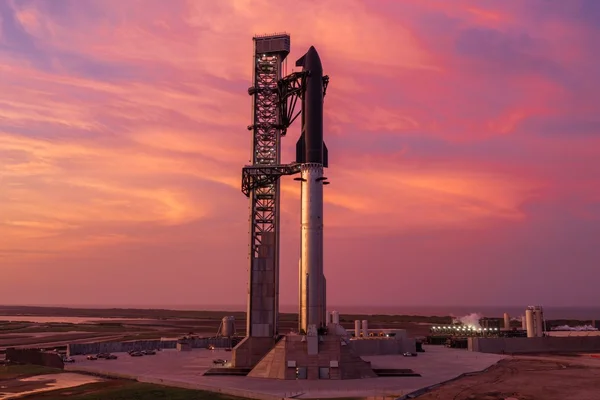
SpaceX completed single-engine and full six-engine static fires of its Ship 41 Starship upper stage at Massey's test site near Starbase in South Texas on August 19 and 20, 2026, the company confirmed via social media. The tests, which included a 15-second single-engine burn on August 19 and a roughly 60-second six-engine burn on August 20, demonstrate the deorbit burn profile planned for the vehicle's first orbital mission. NASA Administrator Jared Isaacman, speaking at the Greater Palm Bay Chamber of Commerce Space Coast Symposium in Cape Canaveral on August 21, said the agency's Artemis III mission could launch from Kennedy Space Center as early as June 2027 — a tighter timeline than the agency had previously communicated.
What Flight 14 Will and Won't Try to Do
If the timeline holds, Flight 14 will be Starship's first orbital launch, the third flight of 2026, and the third to use the upgraded Version 3 (V3) of the vehicle that SpaceX introduced in May. SpaceX will not attempt a return-to-launch-site recovery for Ship 41 on this flight; instead, the upper stage will attempt a soft ocean splashdown at the end of its mission. The Super Heavy first stage, Booster 21, is expected to do the same. SpaceX has successfully caught Super Heavy boosters at Starbase three times using the launch tower's mechanical arms, and two of those boosters have been reflown. A V3 Super Heavy catch has not yet been attempted, and SpaceX founder and CEO Elon Musk said in an August 20 X post that the first Starship ship catch with the tower will happen "in a few months" rather than on Flight 14.
What the Static Fires Validated
The August 19 single-engine test demonstrated the deorbit burn profile for orbital missions, a critical capability because orbital flight requires precise control of the upper stage's reentry trajectory. The August 20 full six-engine burn — captured on video by NASASpaceFlight.com — validated integrated engine performance after transport and stacking. SpaceX still needs to complete integrated operations between Ship 41 and Booster 21 and obtain Federal Aviation Administration approval for the flight profile before declaring the vehicles launch-ready. Industry observers expect Flight 14 to launch in early to mid-September, though SpaceX is unlikely to be aggressive about the timeline for the rocket's first orbital attempt.
Artemis III: A June 2027 Target With Significant Open Work
Isaacman's June 2027 Artemis III target depends on three largely unresolved variables. The Space Launch System rocket is currently being stacked inside the Vehicle Assembly Building at KSC, and Isaacman said the SLS will roll out to Pad 39B for a wet dress rehearsal before the end of the year. Blue Origin's New Glenn and Mark 2 lunar lander are still under development, with Blue Origin continuing to rebuild Launch Complex 36A after a New Glenn explosion during a May 2026 test. And SpaceX's Starship HLS lunar lander variant has not yet flown a lunar-relevant test mission. The Artemis III architecture calls for the SLS to carry Orion, and both a SpaceX Starship and a Blue Origin Mark 2 to dock with Orion in low Earth orbit before any crewed lunar landing is attempted.
Why Isaacman's Timeline Matters
The June 2027 target is meaningful because it aligns Artemis III with the early end of a possible second Trump-administration lunar timeline and leaves limited buffer for any of the three launch vehicles to slip. The White House National Space Transportation Policy released earlier this year set a goal of supporting upwards of 1,000 launches and reentries per year by 2030, and Isaacman's "it's time to get ready" framing at the Cape Canaveral event signaled that NASA is preparing for an order-of-magnitude increase in launch tempo. For SpaceX, Blue Origin, United Launch Alliance and Relativity, the implication is that the next three years will determine whether the U.S. launch industry can sustain the cadence the policy assumes.
What to Watch Through Year-End
Three checkpoints follow. SpaceX's Flight 14 launch attempt, expected in early to mid-September, will be the first time a Starship upper stage reaches orbital velocity and reenters under controlled conditions. NASA's Roman Space Telescope, which completed its launch dress rehearsal on August 20, is targeting no-earlier-than August 30 for launch aboard a SpaceX Falcon Heavy from Kennedy Space Center's Launch Complex 39A. And Blue Origin's New Glenn return-to-flight campaign, which is targeting the end of Q4 2026, will be the first test of whether the company's repaired LC-36A pad and new vertical-integration procedures are ready for routine operations.
Related Articles
SpaceX launches 21 military data satellites for Space Development Agency
The fourth Tranche 1 Transport Layer mission placed 21 Northrop Grumman satellites into low Earth orbit after a five-day delay caused by an auto-abort at T-58 seconds.

Webb and MeerKAT trace most distant fast radio burst to tiny dwarf galaxy 11 billion light years away
The MeerTRAP team spotted FRB 20240304B with MeerKAT in March 2024, and Webb later found its host, a metal poor dwarf galaxy at redshift 2.148, setting a new distance record.
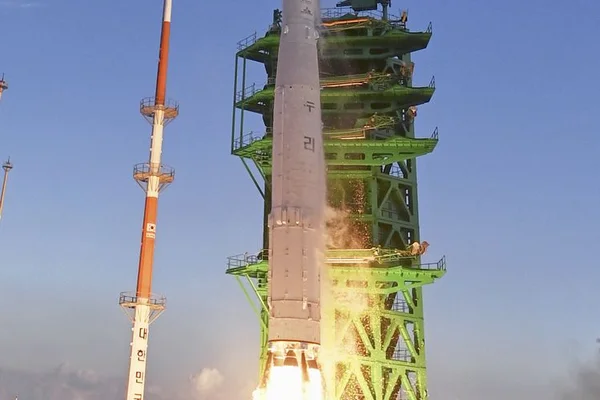
South Korea's Nuri rocket completes fifth flight, deploys 15 satellites
South Korea's homegrown Nuri rocket placed five NEONSAT microsatellites and nine CubeSats into orbit, but one Quaternion CubeSat failed to separate.
Comments (0)
Log in or sign up to leave a comment.
No comments yet. Be the first to share your thoughts.