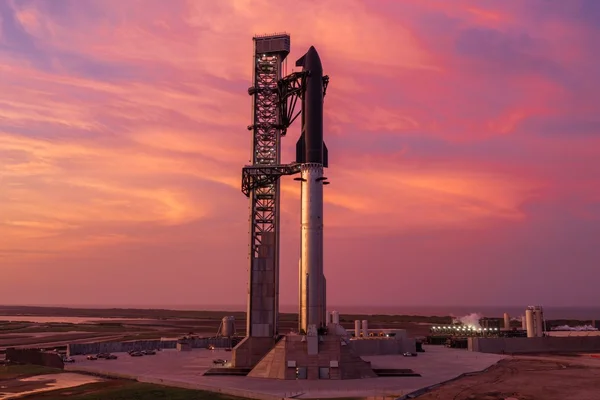
SpaceX announced plans on August 25 to build a $100 billion "Starbase Louisiana" launch facility on Matagorda Island along the Texas-Louisiana coast, Phys.org and Fox 8 reported. The facility is designed to support up to 100 Starship launches per year, with construction phased over five years. The announcement was timed to align with a new White House National Space Council policy targeting 1,000 annual U.S. launches and reentries by 2030.
What Was Announced
The plan, disclosed at a press conference in Baton Rouge by SpaceX President Gwynne Shotwell and Louisiana Governor Jeff Landry, covers a 30,000-acre site with up to six launch pads, an integration hall, a 1.2 million-square-foot manufacturing facility for Starship tanks and Raptor engines, and an associated solar-and-storage microgrid sized for 800 megawatts of continuous power. The first launch from Starbase Louisiana is targeted for late 2028, with full operational capability by 2030.
Shotwell said SpaceX will fund the construction out of operating cash flow and a new $20 billion debt facility, the latter underwritten by a consortium of banks led by JPMorgan and Goldman Sachs. The $100 billion figure covers capex through 2032, including Starship V3 upgrades and the planned Starship V4 first orbital flight in 2029.
White House Policy Context
The White House National Space Council released the new policy framework on August 25, setting a national target of 1,000 annual launches and reentries by 2030, up from approximately 240 in 2025. The framework also prioritizes streamlined FAA launch-licensing, expanded military use of commercial launch, and a $5 billion matching-funds program for state and local governments that host launch sites. Louisiana is the first state to formally apply for the matching program.
The policy is the most aggressive launch-trajectory goal set by any U.S. administration. To meet the 2030 target, U.S. launch cadence will need to more than quadruple from current levels. SpaceX accounts for roughly 60% of current U.S. launches and is expected to carry the largest share of the new target.
Why It Matters
The Louisiana facility would be SpaceX's fourth dedicated Starship launch complex, after Starbase Texas, Kennedy Space Center Launch Complex 39A, and a planned Vandenberg pad. The geographic distribution is designed to support polar, equatorial, and high-inclination orbits without requiring long cross-country transit for fully-stacked Starship vehicles, which are too large to move by road or rail.
For the local economy, the facility is expected to create 12,000 construction jobs and 4,500 permanent positions when fully operational. Critics, including several environmental groups, have raised concerns about the impact on Matagorda Island's wetlands and on the Gulf Coast's brown pelican and Kemp's ridley sea turtle habitats. The Army Corps of Engineers is conducting an environmental review that is expected to take 18 months.
What to Watch Through Year-End
Three checkpoints follow. The Army Corps' Record of Decision on the environmental review, due in Q1 2027, will determine whether the project proceeds on its current timeline. The first flight of Starship V3 from Starbase Texas, targeted for late Q4 2026, will be the first test of whether the architecture is ready to scale to 100-launch cadences. And the Federal Aviation Administration's updated launch-licensing rule, due in November, will indicate whether the White House target of 1,000 annual launches is operationally achievable under current regulatory timelines.
Related Articles

Webb Watches Water Clouds Thicken and Thin on Brown Dwarf WISE 0855
New JWST spectra of WISE 0855, the coldest known brown dwarf, show high water clouds thickening and thinning as it rotates, the first such weather seen beyond the solar system.
SpaceX launches 21 military data satellites for Space Development Agency
The fourth Tranche 1 Transport Layer mission placed 21 Northrop Grumman satellites into low Earth orbit after a five-day delay caused by an auto-abort at T-58 seconds.
Webb and MeerKAT trace most distant fast radio burst to tiny dwarf galaxy 11 billion light years away
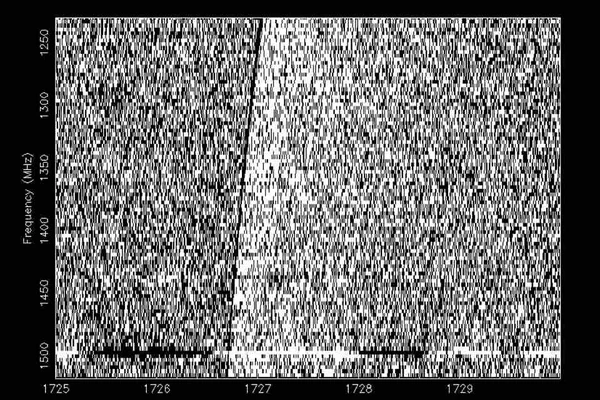
The MeerTRAP team spotted FRB 20240304B with MeerKAT in March 2024, and Webb later found its host, a metal poor dwarf galaxy at redshift 2.148, setting a new distance record.
Comments (0)
Log in or sign up to leave a comment.
No comments yet. Be the first to share your thoughts.