The US Supreme Court on August 22 granted certiorari in Suncor Energy v. Boulder County, agreeing to hear the Canadian oil major's and ExxonMobil's bid to overturn a Colorado Supreme Court decision that allowed Boulder's climate-deception lawsuit to proceed. Oral argument is scheduled for the October sitting, with a ruling expected by June 2027. The case will be the first test of whether federal law preempts state-law claims for harms tied to interstate and international greenhouse-gas emissions — a question with implications for at least two dozen similar cases filed by California, New York, Massachusetts, Rhode Island and Minnesota municipalities.
What Boulder Succeeded
Boulder sued in 2018, alleging that Suncor and ExxonMobil had known for decades that fossil fuel combustion would destabilize the climate and had instead funded a disinformation campaign that delayed local adaptation. The Colorado Supreme Court in March ruled 4-3 that the claims were not preempted by federal Clean Air Act permitting, opening the door to discovery and damages. A district court judge had previously estimated Boulder's adaptation costs at $113 million over 30 years — a small number for an oil major, but a precedent that other municipalities could multiply by an order of magnitude.
What's at Stake for the Industry
The energy companies' lead argument is that federal common law has long governed interstate pollution, and that allowing state-law climate suits would create "balkanized" liability across 50 states. The Trump Justice Department filed an amicus brief in support, arguing that federal preemption is necessary to avoid "conflicting obligations" on a single national industry. The plaintiffs' counter is that federal common law was displaced by the Clean Air Act only for emissions, not for the tort of fraud, and that Boulder's complaint is fundamentally about deception, not pollution. The court added a question on its own jurisdiction over international defendants — Suncor is Canadian — that could narrow the case to ExxonMobil alone.
The Amicus Landscape
Nearly 70 amicus briefs have been filed, with the largest number from municipal governments asking the court to preserve state remedies. The US Conference of Mayors, the National League of Cities and 38 individual cities — including Miami, New York, San Francisco, Boston, Houston and Phoenix — warned that without state-law remedies, "local taxpayers will bear the full cost of climate adaptation that they did not cause." Industry amici include the American Petroleum Institute, the US Chamber of Commerce and the National Association of Manufacturers. The Trump administration's brief is the most consequential: it is the first time the DOJ has weighed in on the merits of state climate torts since the Obama-era Chesapeake Bay Foundation v. Whitman case.
The Possible Outcomes
Four scenarios are most plausible. A broad federal-preemption ruling for the energy companies would shut down all state climate-accountability suits and shift rising adaptation costs onto local taxpayers — the outcome municipal amici are bracing for. A narrow ruling for Suncor on the international-defendant question would let the Boulder case proceed against ExxonMobil but signal that foreign companies are protected, a strange outcome that could invite retaliation from EU courts. A ruling for Boulder would set off a wave of new state suits and accelerate settlement pressure on the industry. And a narrow procedural ruling that sends the case back to the Colorado Supreme Court would leave the underlying question unresolved but buy the parties another 18 months of litigation.
What to Watch Through Year-End
Three checkpoints follow. The October 5 oral argument will be the first live test of where the court's six-justice conservative majority — which has expanded the major questions doctrine across administrative law — stands on state-law climate remedies. The opening of discovery in the parallel New York and Massachusetts suits, currently stayed pending the Supreme Court's decision, will signal whether the court's grant of certiorari freezes all related litigation or only the Colorado case. And California's SB 1497, which would create a dedicated climate-liability fund for municipalities, will be heard in committee in September — the first legislative response to the court's grant and a signal of how states will adapt if Boulder loses.
Related Articles
September 2026 was Earth's second warmest on record as oceans set all time heat mark
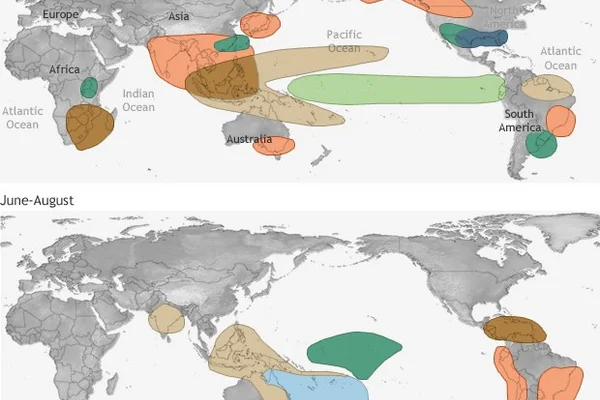
NOAA NCEI reports September 2026 ranked as the second warmest September globally while global ocean surface temperatures hit an all time monthly record, driven by a record strength El Nino.
Hurricane Isaias Becomes Latest First Atlantic Hurricane Since 1905 and Reaches Category 3
The National Hurricane Center says Isaias packed 120 mph winds and 959 mb as it closed on the western Florida Panhandle, forcing evacuations and shutting in 63 percent of Gulf oil output.

Italy and Czech Republic Seek Temporary Suspension of EU Carbon Market
A joint letter from Rome and Prague asks Brussels to pause the EU Emissions Trading System and delay ETS2, arguing that high energy and carbon costs threaten European manufacturing.
Comments (0)
Log in or sign up to leave a comment.
No comments yet. Be the first to share your thoughts.