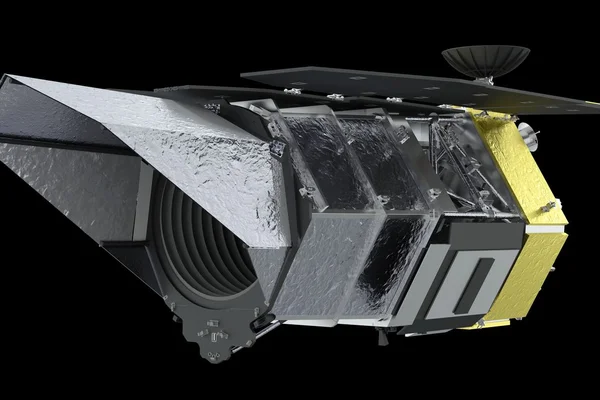
NASA's Explorers Program has long been a proving ground for astrophysics missions that are smaller and more nimble than the agency's flagship observatories. On September 23, 2026, NASA announced that it has selected a far-infrared space telescope called PRIMA, short for PRobe far-Infrared Mission for Astrophysics, to advance to Phase B. This makes PRIMA the first mission in a new class called Probe Explorers, which sits within the Explorers Program and was recommended by the National Academies' 2020 Decadal Survey.
PRIMA is designed to open a relatively unexplored window on the universe: far-infrared light. According to Caltech, the observatory will feature a cryogenically cooled 1.8-meter (5.9-foot) telescope. It will carry two instruments: an imaging polarimeter named PRIMAger, which will map large areas of the sky, and a high-resolution spectrometer called FIRESS for multimode spectroscopy. PRIMA will observe wavelengths from 24 micrometers to 235 micrometers, a range that bridges the gap between existing infrared observatories such as the James Webb Space Telescope and radio telescopes.
The mission's science goals are ambitious. NASA said PRIMA will study the origins of planets outside our solar system, how galaxies and their black holes grew and evolved over cosmic history, and how dust and heavy elements built up over time. By examining radiant energy that only emerges in the far-infrared, the telescope will address questions that other observatories cannot easily tackle. Caltech noted that the telescope and its detectors will be cooled to hundreds of degrees below zero to cut thermal noise, making PRIMA orders of magnitude more sensitive than previous far-infrared space missions.
NASA's Jet Propulsion Laboratory in Southern California will manage the mission. Other partners include NASA's Goddard Space Flight Center in Maryland and NASA's Marshall Space Flight Center in Alabama. International contributions are expected from CNES, ASI, DLR, CSA, KASI, JAXA and the UK Space Agency. Caltech's IPAC will serve as the mission science center, receiving, processing and archiving raw data, and scheduling astronomers' time on the telescope.
Key Facts
NASA announced on September 23, 2026 that PRIMA is advancing to Phase B, the stage of development that advances preliminary design and technology development. The mission is subject to a confirmation review, based on technical, programmatic and cost performance, to determine its readiness to begin Phase C implementation. If confirmed, PRIMA's project cost is capped at $1.2 billion, not including launch and other non-project costs. The observatory will be targeted to launch in 2033, for a planned five-year mission.
The telescope's aperture measures 5.9 feet, or 1.8 meters, and it will be cryogenically cooled. PRIMA will conduct deep, sensitive surveys of the universe in far-infrared light. Its wavelength range spans from 24 micrometers (one-third the thickness of a human hair) to 235 micrometers. Caltech describes the observatory as a $1 billion observatory, though NASA's cost cap is set at $1.2 billion for the project itself.
Once operational, about 75 percent of PRIMA's observing time will be available to the general science community through peer review. Caltech reported that the team has already received nearly 200 ideas from over 400 astronomers. This high level of community engagement suggests strong interest in far-infrared science.
Nicky Fox, associate administrator of NASA's Science Mission Directorate, said: "The PRIMA mission is humanity's next window into the deep universe. It will unveil the obscure across cosmic time to better understand the formation of planets, stars, black holes, and even how water on Earth came to be." Shawn Domagal-Goldman, director of NASA's Astrophysics Division, said PRIMA extends the fleet's survey capabilities into far-infrared wavelengths, kicking off the next decade after Webb and Roman.
JPL said on September 23 that the mission will be managed by the laboratory, and that international partners include CNES, ASI, DLR, CSA, KASI, JAXA and the UK Space Agency. Caltech reported on September 23 that its IPAC will serve as the mission science center. Space & Defense reported on September 24 that NASA has selected PRIMA as the first mission in the Probe Explorer class.
Analysis
The selection of PRIMA as the first Probe Explorers mission is a significant strategic move for NASA. What this really means is that the agency is betting on a new model of astrophysics mission: one that is larger than a typical Explorer but smaller than a flagship, with a cost cap that keeps it within reach. The $1.2 billion cap, excluding launch costs, positions PRIMA between the agency's medium-class Explorers and its multi-billion-dollar flagships like the James Webb Space Telescope. This tier could allow NASA to address high-priority science questions more frequently and with less financial risk.
The choice of far-infrared astronomy is also telling. The far-infrared is a challenging wavelength range from the ground, and previous space missions in this regime, such as the Herschel Space Observatory, ended years ago. PRIMA will fill a gap that has existed for more than a decade. By bridging the gap between Webb and radio telescopes, PRIMA will provide a unique view of cold dust, early galaxies, and planet-forming disks. The mission's sensitivity, thanks to its cryogenically cooled telescope and advanced detectors, will be orders of magnitude better than previous far-infrared missions.
Another key aspect is the international collaboration. With seven international partners contributing, PRIMA is a global effort. This spreads the cost and expertise, and it ensures that the mission has broad support. The involvement of Caltech's IPAC as the science center, along with JPL's management, leverages decades of experience in infrared astronomy. The fact that about 75 percent of observing time will be open to the community is also important. It means that the benefits of PRIMA will be widely shared, and it encourages a broad range of science investigations.
However, the mission still faces a confirmation review. The review will assess technical, programmatic and cost performance. If PRIMA fails to pass, it could be cancelled or delayed. But the fact that it has advanced to Phase B is a strong vote of confidence. The Probe Explorers class itself is new, and PRIMA is its first mission. Its success or failure could shape the future of this class.
Why It Matters
PRIMA matters because it will address some of the most fundamental questions in astronomy. How did planets form outside our solar system? How did galaxies and their black holes grow and evolve? How did dust and heavy elements build up over cosmic time? These questions are central to our understanding of the universe. Far-infrared observations are uniquely suited to answering them because cold dust and gas emit most of their energy at these wavelengths.
The mission also matters for the broader astronomy community. With 75 percent of its observing time available through peer review, PRIMA will support a wide range of research projects. The nearly 200 ideas submitted by more than 400 astronomers even before launch demonstrate the community's enthusiasm. This level of engagement can help ensure that the mission produces a rich legacy of scientific results.
Furthermore, PRIMA represents a new way of doing business for NASA. The Probe Explorers class is designed to be more frequent and more affordable than flagships, while still delivering transformative science. If PRIMA succeeds, it could pave the way for more missions in this class, allowing NASA to respond more quickly to emerging scientific priorities.
Next Up
The immediate next step for PRIMA is the confirmation review. NASA will evaluate the mission's technical, programmatic and cost performance to determine if it is ready to begin Phase C implementation. If confirmed, the project will move into detailed design and construction. The launch is targeted for 2033, and the mission is planned to last five years.
In the meantime, the team will continue to develop the telescope and its instruments. The cryogenically cooled 1.8-meter telescope, the PRIMAger imaging polarimeter, and the FIRESS spectrometer will all need to be tested and integrated. The international partners will also continue their contributions. If all goes well, PRIMA will begin its deep surveys of the universe in the 2030s, opening a new window on the cold, dusty cosmos.
Related Articles

Stanford study finds Arctic currents sink carbon carrying phytoplankton four times faster
Two Stanford-led papers in the Journal of Geophysical Research: Oceans detail how a Chukchi Sea front drives carbon-rich plankton to the seafloor at roughly four times the normal rate.

Oregon State chemists patent water-based method to separate zirconium and hafnium
Oregon State University chemists have patented an aqueous, solvent-free method for splitting zirconium from hafnium, reporting a selectivity of 33 against an industry standard near 6.5.
NASA powers up Roman Space Telescope 300-megapixel camera for first cosmic survey
The 300-megapixel Wide Field Instrument cooled to minus 225 Fahrenheit before its 18 detectors switched on, while the Coronagraph Instrument passed its own first systems checkout.
Comments (0)
Log in or sign up to leave a comment.
No comments yet. Be the first to share your thoughts.