Advanced packaging has emerged as one of the tightest bottlenecks in the artificial intelligence supply chain. A silicon interposer is a thin piece of silicon containing vertical channels, known as through-silicon vias, that sits beneath processors and memory chips inside advanced AI packages and enables them to communicate at high speeds. Demand for that component now exceeds available manufacturing capacity, and most of the supply sits in Asia, which has made the interposer a strategic weak point for AI chip designers in the United States and Europe.
GlobalFoundries moved to alter part of that picture on October 8, 2026, when it announced a manufacturing agreement with TSMC to establish a United States based supply of silicon interposers for TSMC's CoWoS advanced packaging ecosystem. The multi-year agreement carries a value of $2 billion and an initial term of five years, and it provides a framework for future capacity expansion as demand for advanced packaging grows.
The work will take place at GlobalFoundries' Malta, New York fabrication facility, where the company plans to add capacity. GlobalFoundries said it expects the site to become the first US-based source of silicon interposers supporting advanced packaging technologies, including embedded deep trench capacitor components.
Volume production is expected to begin ramping at the Malta site during the first half of 2028, and shares of GlobalFoundries were up about 4% in premarket trading following the announcement. The deal gives TSMC access to a second geographic source for a component that sits directly beneath the compute dies and memory stacks inside its most advanced packages.
Key Facts
Reuters reported on October 8 that GlobalFoundries said it has reached a $2 billion agreement to make a key component used to link AI processors and memory chips for TSMC at its New York facility. Reuters described the component as a silicon interposer and noted that it sits beneath processors and memory chips inside advanced AI packages, enabling them to communicate at high speeds.
GlobalFoundries announced on October 8 that the agreement has an initial term of five years and provides a framework for future capacity expansion. Under the terms, GlobalFoundries will provide manufacturing service to TSMC and add fabrication capacity at its Malta, New York facility, supporting growing demand for high-performance computing and AI systems.
Data Center Dynamics reported on October 8 that GlobalFoundries has entered into a $2 billion, multi-year manufacturing agreement with TSMC to secure the supply of silicon interposers for TSMC's CoWoS advanced packaging ecosystem in the US. The outlet described silicon interposers as thin pieces of silicon containing vertical channels, also known as through-silicon vias, that support 3D stacking on silicon wafers.
Tech Times reported on October 9 that in TSMC's CoWoS-S architecture the interposer sits between the compute dies and the package substrate and contains thousands of through-silicon vias plus redistribution layers that route signals between the GPU die and HBM stacks, enabling terabyte-per-second memory bandwidth. The same report noted that TSMC controls an estimated 90% of CoWoS-compatible advanced packaging capacity at AI-chip scale, is targeting roughly 130,000 CoWoS wafer starts per month by late 2026, up from about 60,000 in early 2025, and that analysts estimate the supply-demand gap remains around 20%.
Ed Kaste, senior vice president of CMOS Business at GlobalFoundries, said in the announcement that advanced packaging is becoming increasingly critical to delivering the performance, power efficiency and scale required for next-generation AI systems. He added that by providing manufacturing service using GlobalFoundries' trusted US manufacturing footprint, the company is creating a secure, scalable source of essential advanced-packaging elements that will help customers accelerate innovation and strengthen the semiconductor supply chain.
Analysis
The strategic logic here is straightforward. TSMC has more demand for CoWoS packaging than it can serve, and its own capacity is concentrated in Taiwan. Bringing an American interposer supplier into the ecosystem gives TSMC a second geographic source for a component that sits directly in the path of every AI accelerator it ships. The bigger picture here is that advanced packaging, once a back-end afterthought, is now treated as strategic infrastructure with the same supply chain logic that governments and chipmakers apply to leading-edge logic.
What this really means is that GlobalFoundries has found a role that does not require it to compete at the leading edge. GlobalFoundries exited sub-14nm manufacturing in 2018, and it does not build 3nm or 2nm transistors. Interposers do not need them. They need through-silicon vias, redistribution layers, deep trench capacitors and mature, high-volume wafer processing, all of which fit the Malta fab's profile. The $2 billion commitment gives the company a multi-year revenue stream tied to the fastest-growing segment of the semiconductor market without forcing it into a capex race it already declined to run.
For TSMC, the arrangement is a hedge rather than a retreat. Tech Times reported on October 9 that TSMC has not issued an independent statement confirming the deal, which came through GlobalFoundries' own press release and investor channels. That is a notable detail. TSMC's public posture has been that CoWoS capacity is sold out, and CEO C.C. Wei has said CoWoS capacity was sold out through 2026. Outsourcing a piece of the interposer supply to a US fab lets TSMC expand effective capacity without building all of it itself, while also answering political pressure to localize parts of the AI supply chain.
The timing also matters. Volume production is not expected to ramp until the first half of 2028. That is more than a year away, and it means the deal does not solve the current shortage. Instead it creates a framework for the next cycle of expansion, when the gap between AI chip demand and packaging supply is expected to be wider rather than narrower.
Why It Matters
Silicon interposers are one of the few pieces of the AI hardware stack with no meaningful US-based source today. Establishing one at the Malta site gives American AI chip designers a domestic option for a component that sits between their compute dies and their HBM stacks, which matters both for supply security and for the political calculus around semiconductor incentives.
The deal also reframes GlobalFoundries' position. The company is often described as a mature-node foundry outside the leading-edge race. With this agreement, it becomes a supplier to the most advanced packaging ecosystem in the industry, providing manufacturing services that TSMC will fold into CoWoS. That is a meaningful shift in perception, and the roughly 4% premarket move in GlobalFoundries shares suggests investors read it that way.
For the broader AI buildout, advanced packaging remains a constraint. Demand for the technology exceeds available manufacturing capacity, and analysts estimate the supply-demand gap remains around 20% even as TSMC targets roughly 130,000 CoWoS wafer starts per month by late 2026. Adding a US interposer source does not close that gap on its own, but it adds a second lane at a moment when a single disruption in one region could stall AI system shipments worldwide.
Next Up
GlobalFoundries said the agreement provides a foundation to expand capacity over time as customer demand grows, and that the additional manufacturing capacity will provide greater scale and flexibility for delivering advanced packaging solutions across multiple product generations. The company expects to add fabrication capacity at Malta beyond the initial commitment if demand warrants.
Investors and supply chain planners will watch three things: whether TSMC issues its own confirmation of the arrangement, how quickly GlobalFoundries begins tool installation at Malta ahead of the first half of 2028 ramp, and whether the embedded deep trench capacitor components mentioned in the announcement become a standard part of the CoWoS flow. For now, the $2 billion, five-year deal stands as the first serious move to bring interposer production onshore.
Related Articles

Samsung posts record $80.2 billion quarterly profit as AI memory boom lifts chipmakers
Samsung's preliminary third quarter figures point to a 782.5 percent profit jump and a 55 percent operating margin, with TSMC also booking record revenue on the same AI demand.
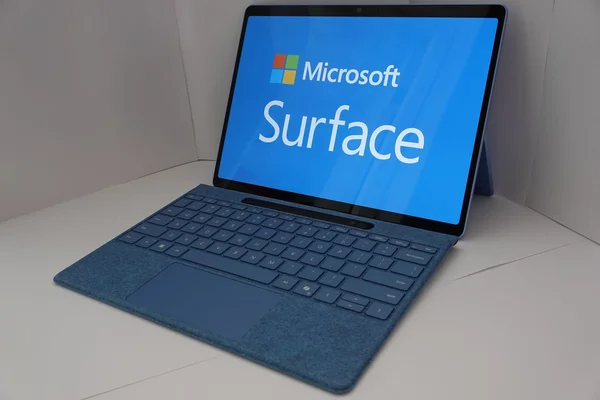
Microsoft Opens Preorders for Surface Laptop Ultra Starting at 2599
The 15 inch Surface Laptop Ultra pairs Nvidia's RTX Spark N1X superchip with up to 128 GB of unified memory and ships October 16 starting at $2,599.
Marvell raises fiscal 2028 revenue target to $20 billion, guides to $70 billion to $90 billion by fiscal 2031
Custom AI data-center silicon is now the center of Marvell's long-range plan, with management telling investors in New York that fiscal 2031 revenue could land between $70 billion and $90 billion.
Comments (0)
Log in or sign up to leave a comment.
No comments yet. Be the first to share your thoughts.