For most of its four decades, ASUS has sold hardware that other people's hands assembled: motherboards, laptops, graphics cards and phones, built in factories where the fine work still belongs to human operators. On 13 November 2026 the Taiwanese company said it intends to supply some of those hands itself. ASUS introduced Gallop, its first humanoid robot, and did something unusual for a debut: it put the machine to work on a real production line inside one of the ASUS group's own electronics factories, packing motherboard accessories.
The reveal was made by Co-CEO S.Y. Hsu during an appearance on CNBC's Squawk Box Asia, and expanded on the same day in a blog post by Dr. Albert Chang, a corporate vice president at ASUS. CNBC reported on 13 November 2026 that Hsu used the segment to set out the robot's commercial path: release to partners in the second half of 2027, and a market launch in 2028. A trade report from Humanoids Daily, published the same day, noted that the machine was already working at a station on an ASUS group production line rather than appearing only in a laboratory demonstration.
The job ASUS chose is deliberately unglamorous. Gallop's first assignment is packing accessories for motherboards, a station where 15 small parts, many sealed in thin clear plastic bags, have to be arranged with each board in roughly 20 seconds. ASUS said in a blog post published on 13 November 2026 that its target is 99.5 percent success within 20 seconds, which the company described as the same standard it holds a human worker to. Small, thin and soft parts are exactly what defeats simple grippers, which is why the company picked this station rather than a cleaner, more rigid task.
What ASUS has not published is equally notable: no measured success rate, no height, weight, payload or battery life figures, and no price. The program itself is young, having started in early 2026, and the company is presenting Gallop as a working development platform rather than a finished product for sale.
Key Facts
Gallop is a two-armed humanoid on a fixed base, built by a Humanoid Robotics business unit inside the ASUS Physical AI Solutions Business Group. ASUS designs the body and a dexterous hand with tactile sensing in house, and sources motors and other standard components from established partners it has not named. A wheeled version is the next step, and the company has said the robot will be shown to customers at Computex 2027 in Taipei.
The packing station is hard for conventional automation because the parts are small, thin and flexible. Hsu said on CNBC that many accessories are very small and placed in plastic bags, so the robot needs special training to handle those kinds of parts well. ASUS argues that a human shaped machine fits workstations and tools designed for people, an advantage in low volume, high mix production where lines are reconfigured often.
Interesting Engineering reported on 13 November 2026 that the entire software stack runs on a single NVIDIA Jetson AGX Thor computer inside the robot. The software is split into four layers: a planner that breaks the job into steps, a supervisor that checks each step and re-plans when something goes wrong, a skills layer that manages reaching, grasping and placing, and a control layer that moves the arms and stops on faults. Fixed interfaces let ASUS swap in newer AI models, which the company says arrive every few months, without rebuilding the robot.
Training does not start from an ASUS foundation model. The company begins with leading open models and builds the task data itself: experienced workers wear a small head camera with consent, simulation generates variations of each demonstration, and an operator in a VR headset and gloves guides the robot using the same parts and cameras as the real station. Recordings from deployed units then feed back into training, closing a loop that ASUS says now works end to end.
Humanoids Daily reported on 13 November 2026 that customer pilots are planned for 2027 and market availability for the second half of 2028, with no specifications or pricing released so far. The unveiling also came a day after Jensen Huang resigned as NVIDIA's chief executive. Asked whether the NVIDIA relationship survived, Hsu said ASUS is working with NVIDIA on Gallop and building it on Jetson Thor. The same report noted that UK robot maker Humanoid made a similar choice in October, replacing two onboard computers with one Jetson Thor.
Analysis
The bigger picture here is that ASUS is betting on integration and factory access rather than on model leadership. The company is not trying to win a race to build the largest embodied AI model, and it says plainly that it starts from open models instead. What it is trying to own is the loop that turns a human demonstration into a reliable line task: the hand, the training pipeline, the four layer software and, crucially, the station where the result is measured every shift.
That choice explains the task selection. A 15 part bag packing job with a 20 second cycle is a statement about where the company thinks humanoids can earn their place first. It is not a showcase of walking or balance. It is a test of whether a machine can absorb the messy, compliant, small object handling that has kept electronics assembly human. By adopting the human benchmark of 99.5 percent within 20 seconds, ASUS is also inviting a comparison that it cannot yet win on paper, because it has released a target rather than a measured rate.
The disclosure gap is the most important caveat in the announcement. A target is a design goal, and 99.5 percent within 20 seconds is a demanding one when the denominator is every part, every board and every shift. Until ASUS publishes a sustained rate, including how often the supervisor layer has to intervene and how often a person is called over, the claim should be read as an engineering specification under test rather than an operational result. The absence of height, weight, payload and battery figures points the same way: this is a platform announcement, not a procurement document.
There is also a structural question about defensibility. If the AI models are open, the computer is an NVIDIA module and the motors come from partners, then the difference between Gallop and a rival machine sits in the hand, the data pipeline and the deployment know how. Interesting Engineering reported on 13 November 2026 that ASUS frames Gallop as a tool for repetitive, physically demanding tasks rather than a replacement for workers, which is the framing every humanoid vendor now uses. The credible version of that argument depends on whether the robot removes the dullest minutes of a shift without adding a new kind of supervision burden.
Why It Matters
Taiwan's electronics manufacturing base is one of the densest concentrations of assembly know how in the world, and ASUS sits inside it as both a brand and a builder for others. If Gallop can be validated at an ASUS group plant, the same station design can be copied across a network of factories that already share processes, tools and supplier relationships. That is a shorter path to real deployment than selling a humanoid to a stranger, and it gives ASUS operational data that competitors must buy or borrow.
The human standard matters beyond this one robot. Electronics assembly has long resisted automation at the final packing stage because the variation is high and the parts are awkward. A machine that matches a person on time and success rate at that stage would shift the economics of low volume, high mix production, which is precisely the segment where dedicated automation is hardest to justify.
ASUS also named the sequence of markets it wants: electronics manufacturing first, then hospitals and service sites. That ordering is sensible, because a factory offers repeatable tasks and measurable output, while hospitals and service sites offer unpredictable environments. The factory is where the data comes from, and the data is what makes the later markets arguable at all.
Next Up
The near term milestones are already public. ASUS plans to fit its own hand, put Gallop on wheels and demonstrate it to customers at Computex 2027, with customer pilots in 2027 and commercial availability targeted for the second half of 2028. Between now and then, the interesting question is not whether the robot can pack a board, but whether ASUS will publish a measured success rate over a sustained run.
Watch for three signals: a disclosed cycle time distribution rather than a single target, any detail on how often the supervisor layer re-plans during a shift, and the first named pilot customer. Those three would turn a well staged debut into evidence that the loop ASUS describes actually holds under production pressure.
Related Articles
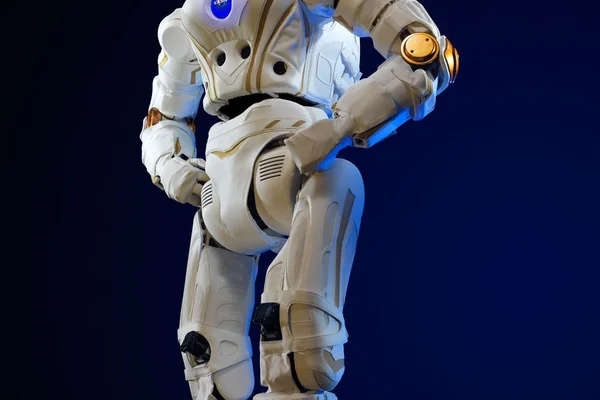
GXO Signs Letter of Intent With Apptronik for Up to 1,000 Apollo Humanoids
GXO Logistics has signed a conditional letter of intent with Apptronik that could put as many as 1,000 Apollo humanoids into its warehouses over four years, starting in North America in late 2027.

SoftBank leads $500 million round in Agile Robots at $8.5 billion valuation
Munich's Agile Robots has secured fresh backing from SoftBank, Nvidia and Hitachi to expand American sales and add German factory capacity for wheeled and legged machines.
Tesla Edges Past Waymo in Texas Driverless Registry With 1,302 Vehicles
A state vehicle registry now shows Tesla's Robotaxi unit five vehicles ahead of Waymo, but the tally tracks authorized driverless cars rather than active paid rides.
Comments (0)
Log in or sign up to leave a comment.
No comments yet. Be the first to share your thoughts.