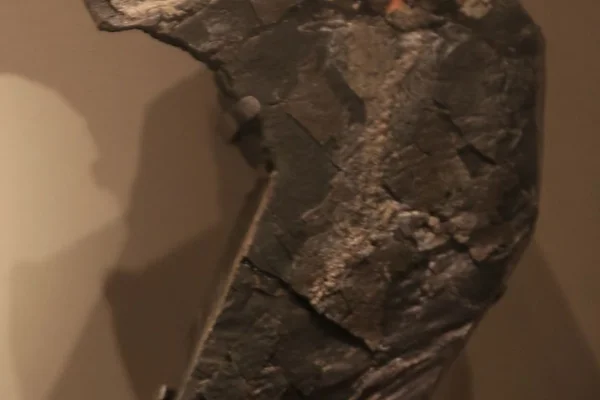
Nearly 80 years after a British expedition photographed a giant fossil on an Arctic island and left it to the icy winds, researchers have identified it as a new species — and a record-breaker. The creature, named Arctobatrachus urdensis, was a roughly 2.7-meter-long amphibian-like predator, making it by far the largest plagiosaurid ever discovered, scientists reported in Papers in Palaeontology.
A 70-Centimeter Skull With a Story
Plagiosaurids were flat-bodied, bottom-dwelling temnospondyls that lived during the Triassic period, with fossils known from Brazil to China. The Bjornoya (Bear Island) specimen was found in 1948, but the expedition could not carry it out; researchers assumed the harsh Arctic winters would destroy it. A Norwegian field party made a chance rediscovery in 1984, and using the 1948 photographs, scientists led by Rainer R. Schoch reconstructed the missing skull portions: 70 centimeters wide but only 21 centimeters long, a near-perfect semicircle armed with large teeth — the signature of an active hunter and likely top predator.
Phylogenetic analysis places Arctobatrachus among the earliest members of the plagiosaurid lineage, giving researchers a rare window into how these bizarre animals evolved: initially active swimmers with less flattened bodies, they later became more sedentary, flatter-bottomed forms. "The fossils have been discovered across the ancient world, but one discovered in 1948 would not be recovered until decades later," the authors note in the paper, which the University of Kansas and German scientists co-authored.
Related Articles

Animals may have evolved 200 million years earlier than fossils suggest, Oxford led study says
A University of Oxford led team argues in Science Advances that animals originated 800 to 700 million years ago by testing microfossils from Mongolia and recalibrating molecular clocks.

Stanford urine RNA test detects 95 percent of localized bladder cancers and predicts BCG response
A new urine cell-free RNA liquid biopsy called uRARE-seq identified 95 percent of localized bladder cancers in a 683-sample study and predicted which patients would benefit from BCG immunotherapy.
Fossil Called World's Oldest Reptile Is Reclassified as Aquatic Amphibian
Synchrotron X-ray scans of the 345 million year old Westlothiana lizziae fossil reveal internal gills and a fish-like mouth, forcing a reclassification as an aquatic stem tetrapod, not the earliest reptile.
Comments (0)
Log in or sign up to leave a comment.
No comments yet. Be the first to share your thoughts.