Agility Robotics became the first U.S. publicly listed pure-play humanoid robotics company on November 5, 2026, when its common stock and warrants began trading on Nasdaq under the tickers AGLT and AGLTW. The Salem, Oregon company reached the milestone after closing its business combination with Churchill Capital Corp XI, a special purpose acquisition company led by financier Michael Klein. Agility Robotics said in its November 5 announcement that the transaction and related financings represented approximately $465 million in gross capital raised before transaction expenses.
The listing gives public investors direct exposure to a category that has spent years moving from research laboratories and trade show stages toward warehouse floors and factory lines. Agility's Digit robot is already deployed with GXO Logistics, Schaeffler and Toyota Motor Manufacturing Canada, and the company cites nearly three years of real world deployment experience and more than 65,000 hours of operation. Those hours span nine customer facilities, a base Agility says separates it from developers stuck in pilots.
The deal valued Agility at $2.5 billion before the new investment. Churchill XI shareholders approved the merger on November 2, with more than 84% of votes cast in favor, and the transaction closed on November 4. SPAC mergers have fallen out of favor after a wave of disappointing debuts, so completing one at a multibillion dollar valuation is itself a signal about investor demand.
The first session offered a mixed verdict. The stock opened at $11.26, above the $10 per share price used in the SPAC deal, dipped below its opening price, and then closed at $11.51, up 2.2%. That gain came on a day when the Nasdaq fell 5.5%, its worst session in 18 months, according to GeekWire. For a company with almost no revenue, beating a sharply weaker market on day one is notable, even if one session says little about long term value.
Key Facts
The capital raised fell short of Agility's projection. The Robot Report reported on November 5 that the roughly $465 million in gross proceeds before expenses included about $164 million from Churchill XI's trust account after redemptions, $201 million from a private investment in public equity led by Foxconn, and a $100 million funding round closed after the SPAC announcement.
The finances are thin. Agility recorded $1.78 million in revenue in 2025, up from $310,000 in 2024, and a net loss of $138.1 million, according to The Robot Report. About 64% of that revenue came from related parties, and the company ended 2025 with $103 million in cash. In the first half of 2026 it generated about $174,000 in revenue, lost $362 million, and held $14.7 million in cash at the end of June, with interim filings flagging substantial doubt about its ability to continue operating.
Digit 5 is the product the listing is meant to finance. Unveiled in September 2026, the robot stands 5-foot-11, weighs 284 pounds, can lift 50 pounds, reach 7.2 feet high, and work more than 20 hours in a 24-hour day. It uses proprietary cycloidal actuator technology designed for repetitive lifting, and Nyobolt niobium batteries that Agility says recharge in nine minutes. Unlike earlier Digits that had to be fenced off, Digit 5 is designed to work alongside people without a safety barrier. SiliconANGLE reported on November 5 that Digit 5 runs some software on Nvidia's IGX Thor system-on-chip series, including the top T7000 model with a 14-core CPU, a computer vision accelerator, and two GPUs, one embedded GPU with 2,560 cores and one standalone chip originally designed for workstations. The robot also uses Nvidia's HALOS software toolkit, which includes hazard avoidance algorithms and resources for securing the safety certifications required for commercial deployment.
Manufacturing is the other half. Agility's RoboFab in Salem is a 70,000-square-foot facility designed for annual capacity of up to 10,000 robots. GeekWire reported on November 5 that Agility has built about 10 Digit 5 robots, with first prototypes just coming off the line, and that early customer access is expected in the first half of 2027, with general availability targeted for the end of 2027.
Orders provide the demand case. Agility says it has more than $300 million in committed multiyear orders for Digit 5, subject to contractual milestones, product features, and specifications. GeekWire reported on November 5 that one unnamed customer committed to a $300 million, three-year contract for 1,000 Digit 5 robots, rented rather than sold, with warrants that vest as robots are deployed. Its robots have been used by nine customers, it has commitments at 12 facilities, and it is in sales talks with more than 30 prospects, aiming for a pipeline of 100 potential customers by the end of 2027.
Analysis
The debut is a financing milestone, not proof of commercial maturity. The bigger picture here is that public markets are now being asked to fund a manufacturing ramp for a product that has only about 10 units built, almost no revenue, and a cash balance that interim filings said raised substantial doubt about continued operations. The $465 million buys time, but it does not buy a proven unit economics story.
The gap between Agility's $2.5 billion pre-money valuation and rival Figure AI's reported $39 billion is the most telling number here. GeekWire noted that Figure is reportedly valued at $39 billion, more than 15 times Agility's merger valuation. A private market can price a humanoid developer on narrative and optionality. A public market marks it daily, and Agility's first close implies a substantial discount to the category's most hyped private peers.
The capital structure also reveals tempered expectations. Agility projected more than $620 million in proceeds if no Churchill XI shareholders redeemed, and it ended up with about $465 million. Redemptions are normal in SPAC deals, but the shortfall, combined with a $201 million PIPE led by Foxconn, means the company is leaning heavily on strategic partners rather than purely financial backers. Foxconn's role as Apple's main iPhone assembly partner, and Nvidia's backing, give Agility supply chain and compute credibility, but they also concentrate influence.
Operationally, the order book is impressive only if it converts. More than $300 million in committed multiyear orders, including a single $300 million, three-year contract for 1,000 rented robots, sounds transformational next to $1.78 million of 2025 revenue. Yet the orders are subject to milestones, product features, and specifications, which means they are not equivalent to recognized revenue. What this really means is that Agility has sold a promise at scale, and 2027 is the year the promise meets the production line.
Why It Matters
For the robotics sector, Agility's listing creates the first U.S. public pure play benchmark for humanoid valuations. Until now, public investors who wanted exposure to the category had to buy diversified industrial or semiconductor companies, or look to Chinese firm Unitree, which Bloomberg reported on November 5 went public in Shanghai in August. Agility now gives funds, analysts, and competitors a daily stock price, quarterly filings, and a disclosure regime against which the entire category can be measured.
For the labor market, the company's pitch is straightforward: humanoids can fill shortages in warehouses and factories, particularly for repetitive lifting and material handling. Digit 5 is aimed at loading materials onto equipment, sorting parts, and inspecting items, tasks that are more complex than the bin stacking handled by Digit 4. If it works as specified, it could change how logistics operators think about shift coverage, safety, and automation economics.
For the broader SPAC market, the deal is a test case. A successful public humanoid company would revive a financing route that has been damaged by poor post-merger performance across other sectors. A stumble would reinforce the view that early stage hardware companies should not rely on blank check vehicles. The $2.5 billion valuation, the $465 million raise, and the 2.2% first day gain on a 5.5% down day for the Nasdaq give the deal a credible opening, but hard evidence will arrive with deliveries, revenue, and cash burn disclosures.
Next Up
The next visible milestones are tightly scheduled. Early customer access for Digit 5 is expected in the first half of 2027, general availability is targeted for the end of 2027, and Agility said GXO will expand Digit to two additional U.S. logistics facilities in early 2027 after the robot moved more than 100,000 totes at a Georgia site. Proceeds are intended for order fulfillment, commercial deployments, Digit production, and platform development, and CEO Peggy Johnson has said Agility is exploring wheeled form factors for consumer facing work and could license its intellectual property.
Public reporting will now arrive on a quarterly schedule, which means investors will quickly see whether the $300 million order book converts into revenue and whether the Salem factory can move from about 10 hand built units toward its 10,000 robot annual design capacity. Agility's first close at $11.51 is a starting point, not a verdict. The market has given the company capital and attention. The next twelve months will determine whether it has given them a business.
Related Articles

China Blocks SoftBank's $5.4 Billion Takeover of ABB Robotics on Security Grounds
Beijing's security review has stopped SoftBank from taking over ABB's robotics division, leaving a $5.4 billion deal in doubt and unnerving investors in Tokyo.
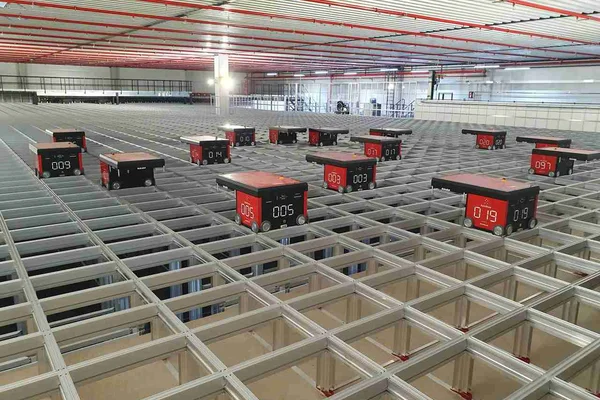
AutoStore Agrees to Buy Dutch Pallet Robotics Firm Logiqs for Up to 30 Million Euros
The Norwegian cube-storage maker will pay cash for a 60-person Dutch developer of roaming pallet systems, adding a warehouse layer that sits beneath its bin-based grid.
Boston Dynamics Rebuilds Stretch Robot With 81 Percent Less Cabling After 100,000 Field Hours
Boston Dynamics rebuilt its trailer unloading robot around field data, cutting internal wiring by 81 percent and shortening a swerve drive replacement from a full day to about an hour.
Comments (0)
Log in or sign up to leave a comment.
No comments yet. Be the first to share your thoughts.