NASA has awarded Blue Origin a contract worth up to $700 million to build a Mars telecommunications orbiter, a decision that hands Jeff Bezos's space company one of the agency's most important planetary infrastructure programs and signals NASA's determination to reduce its reliance on SpaceX. The award, reported by financial and space media on September 3, covers the design, development, integration, launch and operation of a high-performance orbiter that must be delivered by December 31, 2028, with the network expected to become operational at Mars by 2030. The mission is intended to fill a growing gap in the relay network that carries data from Mars surface missions back to Earth, a capability strained by the aging of existing orbiters and the loss of NASA's MAVEN spacecraft in June 2026.
The decision is the latest in a series of moves by NASA to cultivate a second commercial pillar in space after years in which SpaceX became the default launch and deep-space transportation provider. Yahoo Finance reported on September 2 that NASA explicitly framed the award as part of its strategy to have multiple commercial partners, echoing the logic the agency used when it named Blue Origin its second Artemis lunar lander provider in 2023. For Blue Origin, the contract is validation that it can win flagship NASA programs on technical merit rather than as a hedge against SpaceX, and it gives the company a deep-space mission that leverages its New Glenn rocket and its growing spacecraft engineering capacity.
Key Facts
The contract's scope is a full end-to-end responsibility. Keeptrack.space's Space Brief reported on September 3 that the firm-fixed-price award requires Blue Origin to design, build, launch and operate the Mars Telecommunications Network orbiter, with delivery required by the end of 2028 and the network becoming operational around 2030. The orbiter is expected to provide high-bandwidth communications and relay services for Mars surface missions, carrying science data, imagery and navigation information that current Mars orbiters, including the aging Mars Odyssey and Mars Reconnaissance Orbiter, have provided for years but can no longer be counted on to provide indefinitely.
The competitive outcome was a notable upset for Rocket Lab, which was among the eligible bidders that lost the contract. Yahoo Finance reported on September 2 that Rocket Lab had touted its Mars credentials, including building NASA's twin Escapade spacecraft and holding a NASA Goddard study award, and that its loss to Blue Origin surprised parts of the space industry. The company's stock slipped about 2 percent after the announcement, and the loss renewed attention on delays to Rocket Lab's Neutron rocket, whose inaugural launch window for late 2026 is narrowing. The same coverage reported that Cathie Wood's ARK Invest bought the dip, purchasing roughly 705,000 Rocket Lab shares over two days, worth more than $44 million, a bet that the setback is temporary rather than structural.
The infrastructure context explains why NASA is willing to spend at this level. The Mars relay network has been built around orbiters that are well past their design lives, and the loss of MAVEN in June 2026 removed one of the network's key nodes, according to coverage on September 3. A dedicated telecommunications orbiter dedicated to relay rather than science is a different class of asset, one designed to carry the growing volume of data expected from future Mars missions, including sample return campaigns that will require far more bandwidth than current relays can provide. The 2030 operational target suggests NASA is planning the network around the next wave of Mars science, not just the missions currently on the surface.
Analysis
What this really means is that NASA has decided it cannot let the Mars program depend on a single commercial supplier, and it is spending $700 million to buy optionality that it hopes never to need. The agency's relationship with SpaceX has been enormously productive, but it has also created a concentration risk that NASA's leadership has acknowledged in settings from lunar lander selections to human spaceflight reviews. By giving Blue Origin the Mars relay network, NASA is not just buying a spacecraft, it is keeping Blue Origin healthy and experienced enough to remain a credible alternative across the deep-space portfolio, which strengthens NASA's negotiating position with SpaceX on every future program where the two could compete.
The bigger picture here is that the commercial space industry has matured to the point where NASA can treat deep-space infrastructure as a competitive procurement rather than a government-built monopoly. The Mars Telecommunications Network award follows the pattern of NASA's Commercial Lunar Payload Services program and its commercial low-Earth-orbit strategy, in which the agency buys services and capability from private providers instead of owning the hardware. The difference is the destination, Mars relay is not a demonstration or a science mission, it is the communications backbone for an entire planetary program, and trusting it to a commercial contractor that has not yet flown a successful Mars mission is a bet on the maturity of the commercial model that would have been unthinkable a decade ago.
The Rocket Lab angle complicates the narrative. On one hand, the award to Blue Origin shows that NASA values scale and launch cadence, because Blue Origin brings New Glenn and the financial resources of Bezos to a program that will need both; on the other hand, Rocket Lab's loss, its stock slide and the ARK buy-the-dip response highlight how dependent the new-space sector has become on a small number of NASA awards. Yahoo Finance reported on September 2 that retail traders speculated whether recent Rocket Lab executive stock sales indicated advance knowledge of the loss, though the filings showed the sales were made under pre-arranged trading plans. The episode is a reminder that for commercial space companies, a single NASA procurement can move the stock more than a year of operational progress, which is both an opportunity and a vulnerability.
Why It Matters
For NASA, the award secures a dedicated relay capability that the Mars program will need as surface missions grow more ambitious and data-hungry, and it keeps Blue Origin viable as a second pillar across the agency's deep-space portfolio. For Blue Origin, the contract is a proof point that it can win and execute flagship interplanetary programs, and it gives New Glenn a high-profile customer beyond the company's own projects. For Rocket Lab, the loss is a setback that raises the stakes for the Neutron rocket's first flight, because the company's path to larger NASA contracts increasingly depends on having its own medium-lift vehicle flying. And for the broader commercial space economy, the award reinforces that NASA is willing to pay premium prices to maintain competition, a signal that will shape how companies bid on future deep-space infrastructure programs.
Next Up
In the coming weeks, watch for details of the contract's performance milestones and the specific launch vehicle Blue Origin plans to use, since the choice between New Glenn and a smaller vehicle will indicate how confident the company is in its rocket's readiness by the late 2020s. Watch also for Rocket Lab's response, including any statements about the Neutron timeline or new customer wins, because the company will need to show investors that the Mars loss is an exception rather than a pattern. The most important long-term signal will be the health of the existing Mars relay network, because if additional orbiters fail before Blue Origin's spacecraft is ready in 2030, NASA will face a relay gap that no contract award, however large, can quickly close.
Related Articles
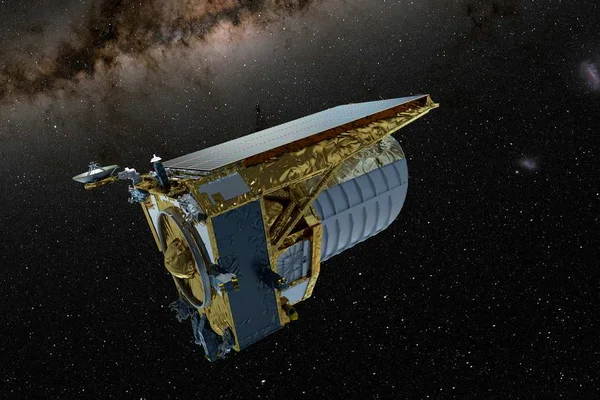
ESA's Euclid Telescope Finds Its First Unknown Comet Beyond the Orbit of Jupiter
A PhD student's motion detection software flagged the streak in survey frames, and ground observatories confirmed the object as a comet on October 8, 2026.

Japan Sets October 20 Launch for World First Phobos Sample Return Mission
The Japanese space agency has confirmed that its Martian Moons eXploration probe will lift off from Tanegashima on an H3 rocket, carrying a German and French rover and NASA instruments to Phobos.

SpaceX asks FAA to allow up to 456 Starship launches a year at Starbase Texas
The Federal Aviation Administration has opened a programmatic environmental review of SpaceX's request to lift its Starbase launch ceiling from 25 flights a year to 456, with public comments due November 30.
Comments (0)
Log in or sign up to leave a comment.
No comments yet. Be the first to share your thoughts.