Japan is preparing to send a spacecraft to Mars's moon Phobos on a five year journey that, if it succeeds, will make the country the first to bring material back from the Martian sphere. The Martian Moons eXploration (MMX) spacecraft is scheduled to lift off aboard an H3 launch vehicle, Flight No. 10, from the Tanegashima Space Center at 04:41:03 a.m. Japan Standard Time on October 20, 2026, which corresponds to 20:41 British Summer Time and 12:41 Pacific Daylight Time on October 19. JAXA, the Japan Aerospace Exploration Agency, leads a mission designed to return at least 10 grams (0.35 ounces) of Phobos soil in a capsule that is expected to land in Australia in 2031.
Phobos is one of two small, potato shaped moons orbiting Mars. It measures about 20 to 30 kilometers (10 to 20 miles) in diameter, orbits Mars at a distance of about 6,000 kilometers (3,700 miles) and circles the planet three times a day. Its smaller sibling is Deimos. Mars is 55 million kilometers (34 million miles) from Earth at the closest point. Scientists hope the five year mission will provide clues to how Phobos and Deimos formed, and shed light on the origins of life in the solar system.
No spacecraft has ever landed successfully on Phobos. Multiple Russian attempts to land there, including one in 2011, failed. Japan has a record of small body sample return: the two Hayabusa missions brought asteroid material home in 2010 and 2020, and Hayabusa-2 returned 5.4 grams of rock and dust. MMX raises the ambition to at least 10 grams collected from a moon of Mars.
MMX is a broad international effort. JAXA leads the project in collaboration with NASA, the French space agency CNES, the German Aerospace Center (DLR) and ESA, with about 20 universities and technology companies also involved. The payload includes a rover jointly developed by France and Germany, a NASA sampling device and gamma ray instrument, and ESA's deep space communication equipment.
Key Facts
The Associated Press reported on October 17 that Japan is set to launch a spacecraft on the world's first mission to bring back samples from Phobos. JAXA said on October 18 that lift off is scheduled for 04:41:03 a.m. JST on October 20, 2026 aboard H3 Flight No. 10 from the Tanegashima Space Center. Makoto Arita, project manager of JAXA's H3 rocket team, said two days before launch that being able to be involved in such a grand mission is incredibly exciting.
ESA reported on October 13 that MMX will be the first mission to collect a sample from Mars's moon Phobos and bring it back to Earth, the first spacecraft to orbit Phobos in a quasi satellite orbit, and the first to collect samples from a moon's surface other than our own. It is also the first mission to return to Earth after visiting the Mars system. ESA supplied the spacecraft's deep space communication equipment and provides ground station support from its Estrack network.
The spacecraft has a mass of about 4,480 kilograms (roughly 5 tons) in three modules: propulsion, exploration and return. Only the return module comes home, carrying the sample in a capsule roughly 60 centimeters across. The propulsion module holds 1,840 kilograms of propellant and the return module 1,190 kilograms. The Associated Press reported that MMX carries 13 instruments, while ESA counts 11 science instruments, seven on the main spacecraft and four on the rover, alongside a radiation monitor, two high resolution cameras and two different sampling devices.
The French and German rover Idefix weighs 25 kilograms and lands first, on a mission of about 100 days around 2029, to help prepare the later Japanese soil sampling. It will provide information for the main spacecraft's landing and analyse the composition and texture of the surface. Phobos's gravity is roughly one two thousandth of Earth's, so the rover would weigh the equivalent of only 15 grams there. JAXA aims to collect at least 10 grams of soil over two sampling attempts, using a NASA pressurized gas device to lift surface dust and a JAXA coring method reaching about 2 centimeters (less than 1 inch) deep. Material from Mars is expected to make up about 0.1 percent of the collected sample.
Landing is difficult because of that weak gravity, and MMX uses four legged landing gear to minimize bouncing. The schedule runs from launch in 2026 to arrival at Mars in August 2027, orbit around Phobos from September 2027, the release of Idefix in early 2029, the main spacecraft's landing and sampling in 2030, and return to Earth in 2031. The sample capsule lands in Australia before being transferred to Japan, to JAXA's ISAS in Sagamihara, where the sample is extracted, catalogued and shared with mission partners.
Analysis
Agence France-Presse reported on October 18 that Japanese scientists are readying a mission to Mars's moons to retrieve samples that could help unlock the origins of the Solar System and life on Earth, in what aims to be the first round trip to the Martian region. The wording is worth noticing: Japan is not only landing on a moon, it is going out, gathering material and coming back, a sequence only a handful of spacefaring nations have completed for any body beyond Earth.
The competitive context is sharpening. The United States Mars sample return effort was effectively cancelled by the Trump administration following a vote by the US Congress in January. China's Tianwen-3 is scheduled for launch around 2028 and hopes to return Mars samples as early as 2031, potentially before MMX's own return. If both schedules hold, the first Martian material to reach Earth could arrive from either programme within months of the other.
The bigger picture here is that MMX turns a small, unglamorous target into a strategic asset. Phobos is only 20 to 30 kilometers across, yet MMX project manager Yasuhiro Kawakatsu describes the Martian moons as the most important unclimbed mountains in the solar system. JAXA has also said the mission will explore using Phobos as a natural space station by establishing requirements for a round trip to Mars, something the agency calls essential for crewed Mars exploration.
The engineering judgement is similar. Landing on a body with one two thousandth of Earth's gravity is not a scaled down lunar landing, because bouncing is the enemy, which is why MMX relies on four legged landing gear and why the 25 kilogram Idefix rover goes first as a scout for the sampling attempt that follows. Its 100 day campaign is a de risking step, not a scientific afterthought.
Why It Matters
The scientific payoff rests on a question researchers have argued over for decades: how did the Martian moons form? One hypothesis holds that the moons are debris from a large object crashing into Mars, the giant impact idea. The other holds that they are captured asteroids. A returned sample is the surest way to settle the dispute, which is why MMX principal investigator Kiyoshi Kuramoto has said the team can almost certainly come to a conclusion by analysing Phobos soil samples.
There is also a habitability thread. Patrick Michel, a French astrophysicist working on Idefix, has said MMX will shed light on the transport mechanisms that delivered water, volatiles and organic compounds from the outer Solar System to the inner rocky planet region, processes that may have played a key role in making these worlds habitable. Elliot Sefton-Nash, ESA's MMX project scientist, describes the data and samples returned by MMX as a window to study the evolution of Mars and the Solar System.
For Japan, the mission carries institutional weight as a world first led by JAXA, and the samples will be extracted, catalogued and shared with mission partners. For everyone else, the value is simpler: material from a moon other than our own has never been available for laboratory study on Earth, and the mission is also a rehearsal for the deep space operations that crewed Mars exploration would demand.
Next Up
The immediate step is the launch itself, set for 04:41:03 a.m. JST on October 20, 2026 from Tanegashima aboard H3 Flight No. 10. JAXA's MMX project site, retrieved on October 18 and 19, describes it as a world first sample return mission to the Martian sphere and says the five year journey now begins. If lift off goes as planned, MMX faces roughly a year of cruise before arriving at Mars in August 2027 and entering orbit around Phobos in September 2027.
From there the sequence is patient: Idefix is released in early 2029 for its 100 day campaign, the main spacecraft lands in 2030 to collect and pack at least 10 grams of regolith into the return module, and the capsule is expected back at Earth in 2031, touching down in Australia before its contents travel to JAXA's ISAS in Sagamihara.
Related Articles

Astronomers identify WD J1330+6435, the first star that would look green to human eyes
A University of Warwick team says the white dwarf WD J1330+6435, about 280 light-years away in Draco, would look chartreuse to the human eye, a first for any star.

Shanidar Neanderthal Spear Wound May Be Earliest Known Case of Lethal Attack
A 15 mm hole in a 75,000-year-old shoulder blade from Shanidar Cave points to a wooden spear as the likely cause of death, while a healed facial wound suggests the same Neanderthal received care.
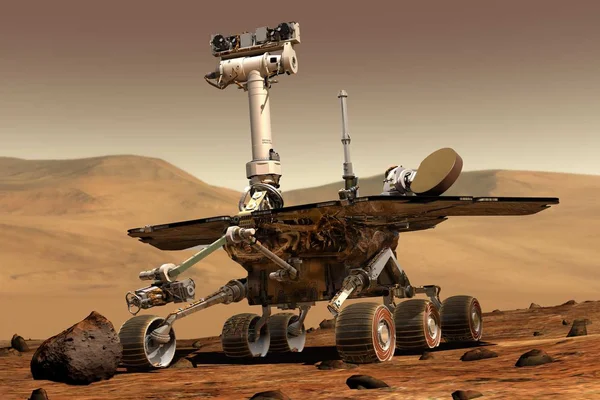
NASA's Perseverance rover breaks Mars driving distance record set by Opportunity
Perseverance passed Opportunity's 28.06 mile mark on its 2,006th sol, with an autonomous navigation system handling more than 90 percent of the driving.
Comments (0)
Log in or sign up to leave a comment.
No comments yet. Be the first to share your thoughts.