Manaus, the capital of Brazil's Amazonas state and the largest city in the Amazon basin, has now spent a third consecutive day under a blanket of wildfire smoke, with public schools shut and in-person work at municipal offices suspended while air pollution readings stayed far above the levels considered safe. The city of about 2.3 million people sits where the Rio Negro meets the Amazon River, a location that normally delivers some of the most humid air in Brazil. This October, that geography has offered no protection at all.
The smoke has drifted into Manaus from fires burning in municipalities elsewhere in Amazonas and in other states, arriving during the driest stretch of the year. Brazil's dry season was approaching its peak when the haze settled over the capital, turning a recurring seasonal nuisance into an emergency that closed classrooms, emptied offices and pushed residents back to face masks.
The proximate driver is an El Nino event that Brazilian authorities and outside scientists describe as one of the strongest in decades and that is projected to be the strongest on record. The federal government has warned that the pattern will bring more rain and floods to southern Brazil while intensifying drought and wildfires in the north. Forecasters expect the episode to peak in December, and Amazonas is already absorbing the consequences months ahead of that peak.
On October 10, 2026, Governor Roberto Cidade and the Amazonas state government declared a state of emergency in 36 municipalities because of forest fires and heavy smoke. Brazil's federal government recognized the decree within hours, a step that allows authorities to request federal funding and deploy aircraft. The areas covered include Manaus and its metropolitan area, the southern part of the state, and river cities including Itacoatiara, Parintins, Tefe, Humaita and Labrea.
Key Facts
The pollution readings explain why the state acted. On the morning of October 10, a sensor operated by the state environmental secretariat in Manaus recorded a PM2.5 fine-particle concentration of 209.1 micrograms per cubic meter, far above the normal range of about 3 to 9. The Rio Times reported on October 10 that the measurement came as smoke persisted over the capital for a third consecutive day, and that monitors in Itacoatiara, roughly 175 km east of Manaus, registered 2,016.1 micrograms per cubic meter, prompting civil defense officials to send mask alerts.
The Associated Press reported on October 9 that the city government said in a statement that the concentration of pollutants averaged 196 micrograms per cubic meter, a level it called unhealthy and one that sits dozens of times above typical background readings. Municipal schools in Manaus had closed on October 9, and all planned outdoor events for October 11 and 12 were suspended. Between October 1 and 8, the city recorded 82 emergency medical calls related to smoke.
The fire count behind the haze has risen sharply. Agence France-Presse reported on October 9 that Amazonas recorded more than 3,700 fire hotspots in September, nearly four times as many as the previous year, according to satellite data from Brazil's National Institute for Space Research, known as INPE. The Rio Times reported on October 10 that the September tally was 3,726 satellite heat spots in Amazonas, against 942 in September 2025. On a single day that week, more than 749 fires were burning, a surge that fed directly into the poor air quality over Manaus.
At the scale of the Brazilian Amazon, The Associated Press reported on October 9 that the region had recorded about 33,556 fire hotspots in 2026 as of October 8, nearly 50 percent more than the same period in 2025, though still about 53 percent below the historical average. Hotspots shifted south toward Manaus and Santarem as the season progressed, which is why Amazonas became the center of the story.
The drought is measurable. According to Brazil's National Institute of Meteorology, known as INMET, Manaus received 44 mm of rain from July through September, against a normal 202 mm for that window, with no rain at all in August. Agence France-Presse reported on October 9 that temperatures in Manaus reached 40 degrees Celsius (104 Fahrenheit) on Thursday and that authorities urged people to avoid exercising outdoors. The response has been substantial: four Air Tractor firefighting aircraft and two helicopters arrived in Manaus, and 290 federal firefighters were sent to the state. Brazil's Environment Ministry said it deployed fire crews and aircraft and stepped up inspections to curb new fires and investigate illegal use of fire, adding that 229 fires have been extinguished in Amazonas since the start of the critical season while teams from the environmental agency Ibama are still working on 20 fires.
Analysis
The bigger picture here is that Manaus is not experiencing a freak event so much as an early reading of a fire regime that scientists expect to intensify. INPE researcher Luiz Aragao said most fires begin in pastures and on already-cleared land, and that drought then lets fire spread into standing forest. That sequencing matters: the flames are largely set by people clearing land, but the dryness produced by El Nino determines how far they travel and how long the smoke lingers.
Data from the 2023 and 2024 El Nino episodes shows what that combination can do. During those events, temperatures rose 2 to 4 Celsius above the forest's historical average, fueling the Amazon's worst wildfires in two decades. Several studies suggest El Nino's effects could be more severe again in 2027. Against that baseline, a September in which Amazonas registered nearly four times as many hotspots as the year before looks less like an anomaly and more like a trend line being drawn in real time.
The public health arithmetic is blunt. Pollution in Manaus is measured in the hundreds of micrograms per cubic meter when normal readings are single digits, and the city documented dozens of emergency medical calls in eight days. Public-sector worker Erlan de Santos, 55, told AFP in Manaus that both the smoke and the heat contribute to breathing problems and that the situation is distressing. When a city tells students and office workers to stay inside for three straight days, the economic cost accumulates alongside the medical one.
It is also worth being precise about what an emergency decree does. It unlocks federal money and aircraft and formalizes the state's authority to act, but it does not extinguish a single fire. The 229 fires put out since the start of the critical season, set against 3,726 hotspots in September alone, describe a response that is real but small relative to the landscape it is defending. The gap between those two numbers is the honest measure of how much of this crisis is being managed rather than solved.
Why It Matters
The Amazon is the world's largest tropical rainforest and stores vast amounts of carbon, giving it a central role in any effort to slow global warming. Smoke that forces the closure of schools in the region's biggest city is the visible symptom. The deeper concern is what repeated drought and fire do to the forest's capacity to keep absorbing carbon if flames keep reaching standing trees.
There is a political dimension as well. Recognition of the state decree by the federal government within hours signals coordination between Brasilia and Manaus at a moment when funding, aircraft and 290 federal firefighters can be moved quickly. That coordination is not guaranteed in Brazilian disaster response, and it is a meaningful part of why the state could act across 36 municipalities.
And the season is not over. The El Nino episode is projected to peak in December, which means the drought conditions that made October so punishing are likely to persist or worsen before they ease. For the 2.3 million residents of Manaus, and for the river communities covered by the municipal decrees, the emergency declared on October 10 is a starting point rather than an end state.
Next Up
No date has been set for Manaus public schools to reopen, and planned outdoor events for October 11 and 12 have been suspended. Air quality readings from the state environmental secretariat's sensors will determine when classrooms and municipal offices return to normal, and the same network will show whether conditions in Itacoatiara and other river cities improve or deteriorate.
Beyond the coming week, attention turns to whether the projected December peak in El Nino brings the rain that INMET records show the region is missing, or extends a drought in which Manaus received 44 mm of rain from July through September against a normal 202 mm. Federal firefighters, four Air Tractor aircraft and two helicopters remain in the state, and Ibama teams are still working on 20 fires. Whether that deployment proves sufficient depends on how many of the next fires start in pasture and how much standing forest they reach.
Related Articles
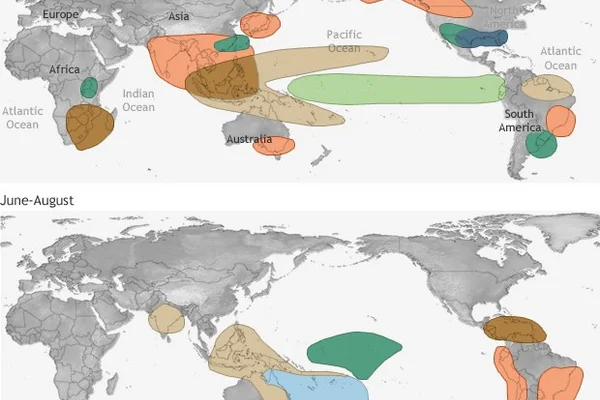
September 2026 was Earth's second warmest on record as oceans set all time heat mark
NOAA NCEI reports September 2026 ranked as the second warmest September globally while global ocean surface temperatures hit an all time monthly record, driven by a record strength El Nino.
Hurricane Isaias Becomes Latest First Atlantic Hurricane Since 1905 and Reaches Category 3
The National Hurricane Center says Isaias packed 120 mph winds and 959 mb as it closed on the western Florida Panhandle, forcing evacuations and shutting in 63 percent of Gulf oil output.

Italy and Czech Republic Seek Temporary Suspension of EU Carbon Market
A joint letter from Rome and Prague asks Brussels to pause the EU Emissions Trading System and delay ETS2, arguing that high energy and carbon costs threaten European manufacturing.
Comments (0)
Log in or sign up to leave a comment.
No comments yet. Be the first to share your thoughts.