Global mean sea-surface temperature hit a record 21.18°C on August 23, 2026, surpassing the previous record of 21.11°C set in August 2023 by 0.07°C, according to data released simultaneously by NOAA and the Copernicus Marine Service on August 24. The Guardian and the Associated Press both linked the new record to a strengthening El Niño event in the equatorial Pacific, which transferred heat from the subsurface ocean to the surface over the past 90 days, and warned that the warming will have cascading effects on coral reefs, hurricane intensity, and the rate of Antarctic ice-shelf melt.
The New Record
The August 23 daily mean of 21.18°C was the highest daily global mean sea-surface temperature on record in the NOAA Optimum Interpolation Sea Surface Temperature dataset, which extends back to 1981. The previous record of 21.11°C was set on August 16, 2023, during the prior El Niño. The 0.07°C margin is small but consistent with the broader warming trend: the 2020s have produced the four warmest individual days on record, all of them in August, and seven of the ten warmest individual days on record. The Copernicus Marine Service's daily global mean is computed from a different satellite-and-argo-float blend and produced the same August 23 value to within 0.02°C, providing independent confirmation.
Why El Niño Matters
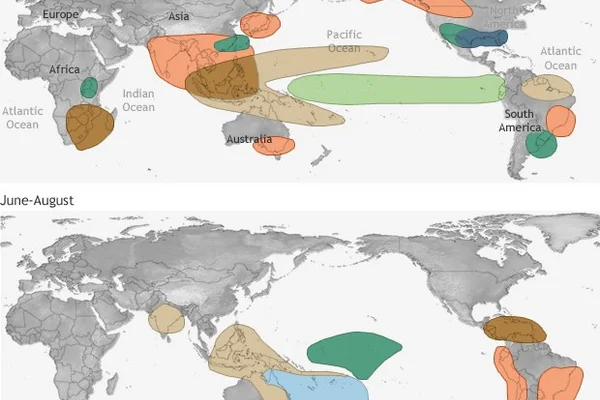
El Niño events warm the equatorial Pacific by 1-3°C above the seasonal norm and shift atmospheric circulation patterns globally. The current El Niño event, which NOAA officially declared in early June, has been strengthening faster than the prior two events in 2023 and 2016, and is now on pace to be a strong El Niño by September. El Niño does not directly cause warmer global oceans, but it does redistribute heat from the subsurface to the surface, temporarily accelerating the warming trend that is fundamentally driven by greenhouse gas accumulation. The current El Niño is expected to peak in November-December 2026 and gradually weaken through Q1 2027, after which global sea-surface temperatures are expected to plateau before resuming their long-term climb.
What the Record Means for Coral Reefs
Coral reefs are particularly vulnerable to ocean warming. When sea-surface temperatures exceed the local climatological maximum for 4-6 weeks, corals bleach and, if the heat stress continues, die. The Great Barrier Reef experienced its sixth mass bleaching event in February 2024, and Australian Institute of Marine Science monitoring released on August 22 shows that the central and northern sections of the reef are now experiencing bleaching-level heat stress for the third consecutive year. The Caribbean, the Coral Triangle in Indonesia, and the Florida Reef Tract are also experiencing widespread bleaching in August 2026, according to NOAA's Coral Reef Watch.
What the Record Means for Storms
Warmer sea-surface temperatures provide more energy to tropical cyclones. The current NOAA and Colorado State University seasonal hurricane forecasts, both updated in early August, predict an above-normal 2026 Atlantic hurricane season with 18-22 named storms and 4-6 major hurricanes, up from the long-term averages of 14 and 3 respectively. The Eastern Pacific basin is also expected to be above normal, with 17-20 named storms. The Western Pacific basin, which is the most active globally, has already produced 14 typhoons in 2026 — the busiest start to a Western Pacific season on record.
What to Watch Through Year-End
Three checkpoints follow. NOAA's monthly global climate report, due September 12, will reveal whether August as a whole sets a new monthly record or whether the August 23 daily peak is an outlier. The peak of the Atlantic hurricane season, which climatologically falls around September 10, will test whether the warm sea-surface temperatures translate into the major-hurricane activity that the seasonal forecast projects. And the UN's COP30 climate conference in Belém, Brazil, scheduled for November 10-21, will be the first COP at which countries negotiate post-2027 emissions-reduction commitments with the latest ocean-temperature record as backdrop.
Related Articles
September 2026 was Earth's second warmest on record as oceans set all time heat mark
NOAA NCEI reports September 2026 ranked as the second warmest September globally while global ocean surface temperatures hit an all time monthly record, driven by a record strength El Nino.

Hurricane Isaias Becomes Latest First Atlantic Hurricane Since 1905 and Reaches Category 3
The National Hurricane Center says Isaias packed 120 mph winds and 959 mb as it closed on the western Florida Panhandle, forcing evacuations and shutting in 63 percent of Gulf oil output.

Italy and Czech Republic Seek Temporary Suspension of EU Carbon Market
A joint letter from Rome and Prague asks Brussels to pause the EU Emissions Trading System and delay ETS2, arguing that high energy and carbon costs threaten European manufacturing.
Comments (0)
Log in or sign up to leave a comment.
No comments yet. Be the first to share your thoughts.