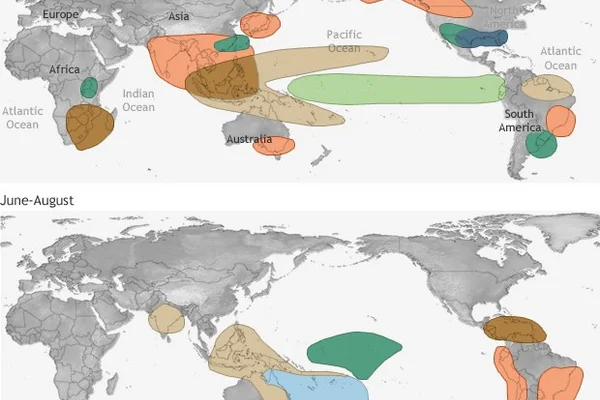
The world's oceans reached their highest temperature on record over the weekend of August 22-23, the European Copernicus Climate Change Service announced Monday. Average global sea-surface temperatures hit 21.10°C (69.98°F), narrowly edging out the previous record of 21.09°C (69.96°F) set in March 2024, and confirming that a building super El Niño is still well short of its expected peak between November and January.
Why the Timing Matters
Sea-surface temperatures normally peak in March or April, when the southern-hemisphere summer ends. This year's record was set in August, which means the oceans will continue to warm for months as the El Niño event intensifies. The U.K. Met Office forecast last week that the El Niño will reach roughly 3°C above normal at its peak, well into territory typically called a super El Niño. The most recent very strong events were 1982-1983, 1997-1998, and 2015-2016. Adam Scaife, the Met Office's head of long-range forecasting, said in a statement that he had never seen an El Niño signal this intense in his forecasts.
What Scientists Are Watching
The record is being driven by two reinforcing factors: the still-strengthening El Niño, which is adding heat to the system, and decades of human-driven warming, which has warmed the oceans by about 0.8°C overall. Samantha Burgess, strategic lead for climate at the European Center for Medium-Range Weather Forecasts, said the new high was 'another clear signal of an ocean under growing stress.' Hotter oceans fuel more extreme weather, intensify coastal heat waves by reducing the cooling effect of sea breezes, raise sea levels through thermal expansion, and stress marine ecosystems including coral reefs.
Local Impacts Already Visible
The western English Channel has seen almost continuous marine heatwave conditions for more than three years, peaking at 7°C above normal in July, according to Tim Smyth, director of science at Plymouth Marine Laboratory. Indonesia has recorded more than 200,000 hectares burned by wildfires so far this year, roughly three times the size of Jakarta, and the government deployed cloud-seeding aircraft in Borneo. Sri Lanka is delivering water to nearly 72,000 people across seven districts amid a drought the government has tied to the same El Niño. Honduras has placed 80% of its territory, including the capital Tegucigalpa, on drought alert.
What to Watch Through Year-End
Three checkpoints follow. The El Niño is expected to peak between November and January, which means each of the next several monthly sea-surface temperature readings is likely to break the August record. The Met Office said 2026 will 'far exceed' recent El Niño-driven years and that 2027 is more likely than 2026 to become the hottest calendar year on record, because the heat release from El Niño lags the peak by several months. The U.S. is sending a military hospital to Peru's coast next year to help the country cope with the expected El Niño impacts, and similar international disaster-readiness moves are likely through year-end.
Related Articles
September 2026 was Earth's second warmest on record as oceans set all time heat mark
NOAA NCEI reports September 2026 ranked as the second warmest September globally while global ocean surface temperatures hit an all time monthly record, driven by a record strength El Nino.

Hurricane Isaias Becomes Latest First Atlantic Hurricane Since 1905 and Reaches Category 3
The National Hurricane Center says Isaias packed 120 mph winds and 959 mb as it closed on the western Florida Panhandle, forcing evacuations and shutting in 63 percent of Gulf oil output.

Italy and Czech Republic Seek Temporary Suspension of EU Carbon Market
A joint letter from Rome and Prague asks Brussels to pause the EU Emissions Trading System and delay ETS2, arguing that high energy and carbon costs threaten European manufacturing.
Comments (0)
Log in or sign up to leave a comment.
No comments yet. Be the first to share your thoughts.