The El Niño event developing over the Pacific Ocean is likely to be the strongest in living memory, the UK Met Office has warned. The powerful natural climate phenomenon pushes up global temperatures and can increase the risks of extreme weather. Added to the effects of human-induced climate change, the Met Office says it is "very likely" to mean 2027 is the hottest year on record globally.
The Forecast Numbers
Latest forecasts from the Met Office suggest that warming in the key Pacific monitoring region could exceed 3°C later this year as El Niño nears its peak. That would be unprecedented in records going back to 1950, and probably the strongest event since the 19th century. Very high temperatures in the deeper ocean — around 8°C above normal at a depth of 100 meters in some places — could help supercharge this El Niño, essentially providing a reservoir of warm-water fuel to reinforce the event. "I have never seen an El Niño signal this intense in our forecasts," said Adam Scaife, the Met Office's head of long-range forecasting.
What's Already Happening
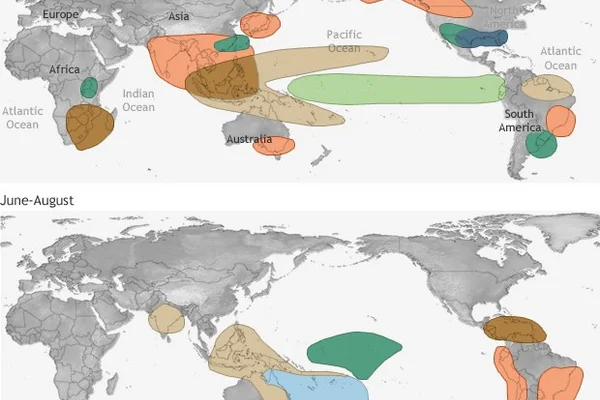
There is growing evidence that weather patterns around the world are already being affected, with below-average monsoon rains in India and suppressed hurricane activity in the Atlantic Ocean. Sri Lanka has arranged for water to be delivered to nearly 72,000 people across seven districts as the country tackles a drought linked to this year's powerful El Niño. Water levels at hundreds of small tanks have dropped to about 10%. The government has allocated 4.8 billion rupees ($14 million) from the budget for water distribution. In Indonesia, wildfires have burned through more than 200,000 hectares since the start of the year — an area around three times the size of Jakarta — with 95,000 hectares burned in July alone.
The Emission Risk
During the strong El Niño in 1997 and 1998, wildfires in Indonesia emitted as much as 2.5 gigatonnes of carbon dioxide into the atmosphere, equivalent to around a third of annual fossil-fuel emissions at the time. The 2015 strong El Niño saw another 1.5 gigatonnes of CO2 from Indonesian fires. "We're still at the start of the season," said Mark Parrington at the European Centre for Medium-Range Weather Forecasts. "If the El Niño is as extreme as the Met Office is suggesting, it wouldn't be a surprise if the wildfires produced emissions totals similar to those that occurred in previous strong El Niños."
2027 as a Climate Tipping Point
Met Office climate scientist Dr Nick Dunstone said the El Niño-driven heat release into the atmosphere is particularly pronounced in the calendar year following the winter peak. "Hence, 2027 is very likely to replace 2024 as the warmest year on record." A separate paper by Gergana Gyuleva at ETH Zurich, published in August, suggested climate models may understate warming by 25% — meaning the Climate Action Tracker's current 2.6°C projection for 2100 could actually be 3.25°C. The El Niño forecast will be the first live test of whether those higher sensitivities are already manifesting in observed temperatures.
What to Watch Through Year-End
Three checkpoints follow. The October-November Pacific sea-surface temperature anomaly — when the Met Office expects the 3°C threshold to be tested — will determine whether 2027 is indeed forecast to be the first calendar year above 1.5°C of warming. Indonesian fire emissions through end of October, tracked by the Copernicus Atmosphere Monitoring Service, will quantify whether the country is on track for a multi-gigatonne CO2 pulse. And the Indian monsoon withdrawal date will signal whether the failure of the southwest monsoon this year was a one-season disruption or a structural shift in South Asian rainfall patterns.
Related Articles
September 2026 was Earth's second warmest on record as oceans set all time heat mark
NOAA NCEI reports September 2026 ranked as the second warmest September globally while global ocean surface temperatures hit an all time monthly record, driven by a record strength El Nino.

Hurricane Isaias Becomes Latest First Atlantic Hurricane Since 1905 and Reaches Category 3
The National Hurricane Center says Isaias packed 120 mph winds and 959 mb as it closed on the western Florida Panhandle, forcing evacuations and shutting in 63 percent of Gulf oil output.

Italy and Czech Republic Seek Temporary Suspension of EU Carbon Market
A joint letter from Rome and Prague asks Brussels to pause the EU Emissions Trading System and delay ETS2, arguing that high energy and carbon costs threaten European manufacturing.
Comments (0)
Log in or sign up to leave a comment.
No comments yet. Be the first to share your thoughts.